The CCM Test Most Buyers Miss Adapt to Vulnerability Without Spreading Sensitive Data
A customer tells a payments provider that a recent bereavement has made it hard to manage an account. The provider needs to respond differently: use clearer language, allow more time, offer a human contact, and avoid an aggressive collections sequence. But the communications platform does not need the bereavement story copied into every template, proof file, delivery log, archive, and analytics feed.
That distinction is becoming a decisive CCM architecture issue. In September 2026, the UK Financial Conduct Authority reported that the strongest payments firms could identify and record vulnerability consistently, tailor support, test communications, define outcomes, and use management information to improve. It also found room for better assurance, more consistent support, stronger monitoring, and better evidence across the customer journey. Around half of UK adults show at least one characteristic of vulnerability, the review said. [1]
The strategic question is no longer whether a CCM platform can personalise. Most serious platforms can. The better question is whether it can personalise with restraint: consume the minimum support signal required, adapt the communication appropriately, and prove the result without distributing the customer's sensitive backstory.
The Personalisation Paradox
The FCA and ICO's joint statement, published in March and updated in July 2026, rejects a false choice between consumer support and data protection. Firms may process vulnerability-related information when appropriate and necessary, but must address lawfulness, fairness, transparency, purpose limitation, accuracy, data minimisation, storage limitation, security, and accountability. Health data and other special-category information require an Article 6 lawful basis and a separate Article 9 condition. High-risk processing may require a data protection impact assessment. [2]
For CCM teams, this creates a productive constraint. A rich customer profile can improve relevance, but every additional field creates another place to govern access, accuracy, retention, testing, logging, and deletion. A platform that can ingest everything is not necessarily a platform that should ingest everything.
The customer-experience cost of mishandling that balance is visible beyond regulatory reviews. Smart Communications' 2026 benchmark, based on online research that it commissioned from Toluna among approximately 4,000 qualified consumers, reports that 48% sometimes or always repeat information when moving between channels or representatives, while unclear communication is the most common reason respondents abandon digital service for a human channel. The study also reports weakening trust in companies to use AI responsibly and securely. These are vendor-sponsored findings, not an independent market benchmark, but they reinforce a practical point: forcing customers to retell sensitive circumstances is not continuity, and automating a poorly governed response is not personalisation. [12]
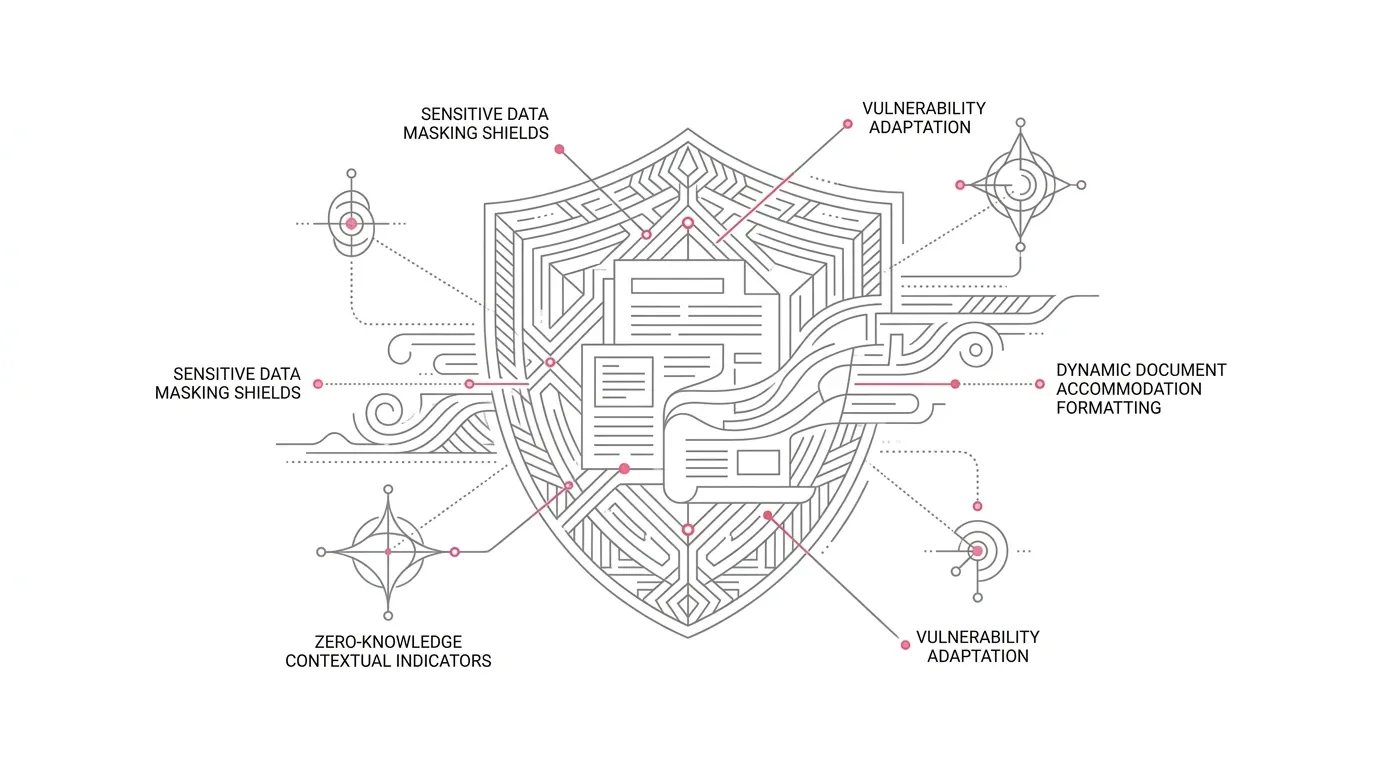
The design principle is simple: separate the reason for support from the instruction needed to deliver support. A servicing system might hold an authorised record of the customer's circumstances. The CCM layer could receive only controlled instructions such as *plain_language_required*, *large_print*, *extended_response_window*, *no_digital_only*, or *human_follow_up*. This is an architectural recommendation, not a universal legal rule: the correct data and lawful basis depend on the use case, jurisdiction, and customer need.
Seven Tests for a Vulnerability Aware CCM Platform
1. Purpose-bound capture. Can the enterprise define why each support signal exists, where it came from, who may use it, and which journeys may consume it?
2. Minimum-data execution. Can the communications service receive a need or treatment instruction without receiving the underlying diagnosis, event narrative, free-text note, or broad vulnerability label?
3. Adaptive communication. Can approved rules alter wording, format, timing, channel, response options, and escalation consistently, including accessible and non-digital alternatives where appropriate?
4. Freshness and expiry. Can a time-bound or changing need be reviewed, corrected, withdrawn, or expired so yesterday's circumstance does not become a permanent identity?
5. Human control. Can trained staff review or override a treatment when context requires it, with clear permissions and accountable approval rather than silent automation?
6. Evidence without overexposure. Can the organisation reconstruct which approved rule, content version, format, channel, and support instruction produced the communication while masking or excluding unnecessary sensitive information from logs and proofs?
7. Outcome feedback. Can teams compare delivery, comprehension, completion, complaints, repeat contact, and harm indicators across relevant cohorts using privacy-conscious aggregation and appropriate governance?
This test challenges a familiar buying assumption. Channel breadth, throughput, installed base, AI features, and centralised governance matter. They do not show whether the platform can deliver a proportionate customer response with a proportionate data footprint. Incumbent familiarity is not evidence of that outcome, and a modern user interface is not evidence either. Buyers should witness the scenario.
Where Perfect Doc Studio Fits
Perfect Doc Studio has a credible foundation for this design. Its current public materials say Smart Templates adapt content to customer context, its visual workflow can route communications based on customer actions or business events, and its integration engine supports APIs, connectors, and custom data mappings. Its document knowledge base describes element-, block-, and flow-level business logic. [4] [5]
PDS also documents an Accessibility Validator with actionable suggestions, an Accessibility Preview, and document-, element-, and block-level summaries. Those capabilities can help authors design clearer outputs and give assistive-technology users a more usable way into complex information. Its versioning model separates Draft, Testing, and Published stages; a Publisher can approve or reject a design, and testing includes data-mapping and output validation. The public product page also describes role-based access, interactive review, workflow automation, and delivery across document, email, SMS, WhatsApp, and voice channels. [6] [7] [8]
These are meaningful building blocks, not proof of the complete control model. In the reviewed public sources, PDS does not verify field-level suppression or masking of vulnerability data, a dedicated minimum-necessary support token, purpose metadata, automatic revalidation and expiry, special-category access segregation, proof and log redaction, a customer correction workflow, or privacy-preserving outcome comparison for vulnerable cohorts. Buyers should treat those as demonstration requirements, not infer them from general personalisation, security, audit, or GDPR statements.
That qualification strengthens the PDS case. PDS should not try to win this evaluation with a generic compliance claim. It should show how quickly business teams can configure a controlled rule, create an accessible variant, route it through testing and approval, publish it across relevant channels, and keep unnecessary sensitive detail outside the communication package. If the platform can demonstrate those steps with appropriate controls, its business-user-first model becomes strategically relevant: the support response can change at the speed of customer need without turning every change into a development project.
Competitors Set a Serious Baseline
Messagepoint publicly describes natural-language targeting rules, readability and plain-language optimisation, translation into more than 60 languages, controlled frontline customisation, review and approval workflows, audit logs, delivery tracking, and channel orchestration. That is a strong combination for clear, governed and situational communication. [9]
Smart Communications says SmartCOMM can use approved customer data and business rules for personalisation, with approval workflows, audit trails, omnichannel delivery, integrations, and AI-assisted readability, tone, formality, and translation. Its broader financial-services proposition connects communications to data collection, journey orchestration, and archiving. These are relevant strengths when support must persist across a multistep journey. [10]
Quadient Inspire publicly combines centralised personalisation and workflow with accessibility capabilities; its 2025 R17 announcement also names real-time sentiment analysis, translation, PII detection, and automated PDF accessibility remediation. PII detection is especially relevant as a protective control, although detection alone does not establish purpose limitation, minimum-data execution, or appropriate retention. [11]
The fair conclusion is not that one vendor has solved vulnerability. It is that each platform should be tested against the same end-to-end scenario. Public feature pages demonstrate ingredients. They rarely demonstrate the data boundary between the system that understands the customer's circumstances and the system that renders the next communication.
Run the Buying Workshop With One Real Journey
Ask each vendor to configure a collections or account-restriction notice for a customer who needs plain language, more time, a large-print copy, and human follow-up. Do not pass the underlying health condition or life event into the CCM payload. Then change one need, withdraw another, and correct an inaccurate flag.
Require the vendor to show the input contract, rule decision, content and format selection, cross-channel behaviour, author and approver permissions, test proof, published version, delivery record, staff override, log content, retention behaviour, and management information. Finally, ask how the organisation would determine whether the adjusted communication improved understanding or completion without creating an unnecessarily revealing analytics dataset.
This test exposes what a spreadsheet hides. It reveals whether business autonomy is governed, whether personalisation is proportionate, whether accessibility is operational, whether audit evidence protects privacy, and whether the platform connects communication activity to customer outcomes.
The Shortlist Decision
The FCA's recent evidence makes one point difficult to ignore: standard communications and thin outcome evidence are not enough for customers in vulnerable circumstances. The FCA and ICO make the companion point: more sensitive data is not automatically better support. Enterprises need both responsiveness and restraint. [1] [2]
PDS belongs in a serious scenario-based evaluation because its verified rule-driven authoring, accessibility tooling, workflow, version control, integration, role controls, and multichannel delivery align with the mechanics of adaptive communication. It must still prove the minimum-data and outcome-evidence controls that the use case demands. That is the right standard for PDS and for every incumbent.
Enterprises that omit PDS while defaulting to familiar names risk optimising for the category's past: the ability to produce more personalised communications from more data. The future of CCM is more exacting. It is the ability to deliver the right support from the least data necessary, under visible human and governance control.
Comparison Evidence
Public-source evidence relevant to the proposed buying test. A blank or unverified item is not evidence that a capability is absent; it is a requirement for vendor validation.
| Platform | Verified public strengths | Relevance to the test | Not verified in reviewed sources |
|---|---|---|---|
| Perfect Doc Studio | Rule-driven templates; accessible summaries, validator and preview; visual workflow; Draft, Testing and Published stages; role controls; integrations; multichannel delivery. | Strong authoring and governance building blocks for adapting content, format and route from a controlled support instruction. | Field-level minimisation or masking; dedicated support token; purpose metadata; revalidation and expiry; correction workflow; proof/log redaction; cohort outcome evidence. |
| Messagepoint | Natural-language targeting; readability and plain-language optimisation; 60+ language translation; controlled frontline customisation; approval, audit and delivery tracking. | Strong content intelligence and controlled personalisation for sensitive or life-changing notices. | Minimum-data boundary; vulnerability-signal lifecycle; field-level proof/log controls; privacy-preserving outcome comparison. |
| SmartCOMM | Approved customer data and business rules; workflow and audit trails; multichannel delivery; readability, tone and translation assistance; connected data collection, orchestration and archiving. | Strong journey continuity and governance across information capture, communication and record retrieval. | Purpose-bound support token; automatic need expiry; special-category segregation; redacted evidence; vulnerability-specific outcome loop. |
| Quadient Inspire | Centralised personalisation and governance; approval and audit; PII detection; translation; sentiment analysis; accessibility design and PDF remediation. | Strong detection, accessibility and enterprise-control capabilities relevant to limiting exposure and adapting output. | End-to-end minimum-data execution; support-need lifecycle; purpose and lawful-basis metadata; customer correction; cohort outcome evidence. |
Executive Takeaway
Decision. Add a minimum-necessary support-signal scenario to CCM selection and renewal. Require vendors to demonstrate how a customer's need changes content, format, channel, timing, and escalation without distributing the underlying sensitive circumstance. Score freshness, correction, expiry, human control, redacted evidence, and privacy-conscious outcome monitoring alongside traditional authoring, scale, and omnichannel criteria.
PDS implication. PDS has enough verified building blocks to merit a shortlist place. The evaluation should focus on whether its integration and governance model can enforce the sensitive-data boundary, not on generic claims of personalisation or compliance.
Call to Action
Ask Perfect Doc Studio for a live vulnerability-aware communication workshop. Bring one regulated journey and a payload containing only support instructions, not the customer's sensitive backstory. Test rule-driven adaptation, accessible output and summaries, testing and Publisher approval, role controls, multichannel delivery, evidence, correction, and expiry. The result will show whether your next CCM platform can combine empathy, speed, and data restraint in the same operating model.