*Why the production batch deserves its own enterprise approval test*
The Risk Begins After Content Approval
At 8:47 on a Monday morning, an operations user selects an approved renewal template and uploads a file for 325,000 customers. The wording is correct. Legal signed it off. Brand approved it. Yet the run can still fail in ways that matter: the audience may include suppressed customers, a source column may be stale, a duplicate file may be submitted, one channel may use the wrong sender identity, or an attachment may be matched to the wrong recipient.
Recent enforcement makes the distinction concrete. In April 2026, the Australian Communications and Media Authority said Latitude Finance paid a A$3.96 million penalty after more than 2.7 million spam-law breaches. The regulator reported that more than 2.3 million messages lacked accurate contact information and 344,416 also lacked a working unsubscribe function. [1] In January 2026, the UK Information Commissioner fined two companies a combined £225,000 for millions of unlawful marketing messages, including more than 67 million emails sent using third-party data without valid consent. [2]
Those cases do not establish that a CCM platform caused the violations, and this article does not make that claim. They demonstrate something more useful for buyers: compliance is judged on the messages actually sent, the people who received them and the controls that operated at dispatch. An approved design is only one input to that result.
The procurement implication is direct. Enterprises should evaluate send-time assurance as its own CCM capability.
Why Conventional CCM Evaluation Misses the Release Decision
Many requirements matrices award one set of points for content workflow, another for batch performance and another for operational dashboards. Each category is legitimate. The separation is the problem. A content approver may never see the final recipient population. An operations dashboard may show a job running correctly without showing whether it should have run. A proofing screen may render attractive samples while missing the segment where the defect sits.
Installed base, peak throughput, channel count and years of product history can all matter. None answers the release question: can the organization show that this exact job, using this exact data and these exact approved assets, was safe to send to this exact population? A modern evaluation should make every shortlisted platform answer that question in a live scenario.
What Send Time Assurance Must Prove
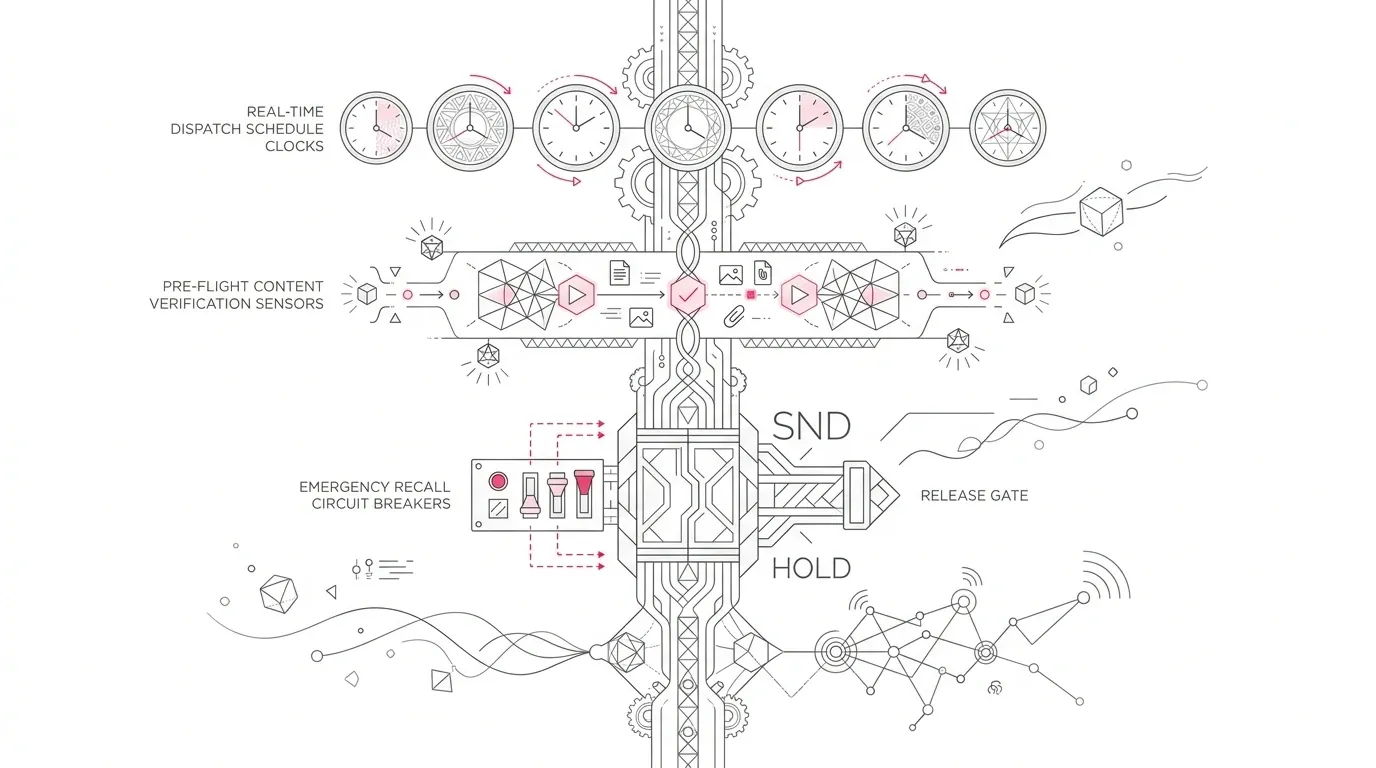
Send-time assurance is the governed decision that authorizes a defined communication job to move from prepared to executable. It joins content governance with production operations. A credible control model should make six things observable.
- Approved intent The job should identify the approved template and version, permitted purpose, channel variants, sender identity, schedule and data contract. The approver should not have to infer these from filenames or a separate ticket.
- Population proof The platform or its connected control layer should show recipient count, change from the expected population, duplicate and missing-key checks, suppression results, channel eligibility and material exceptions. A record count alone is weak evidence.
- Output proof Sampling should cover risk, not convenience. First and last records are useful, but buyers should also test boundary values, rare rule paths, languages, attachments, unusually high or low amounts and each selected channel.
- Accountable release The approval record should capture what the reviewer saw, who approved it, when the decision occurred and whether the job changed afterward. Higher-risk jobs may need maker-checker separation, multiple approvers or an approval that expires when data or configuration changes.
- Controlled execution Operations need duplicate prevention, pause or cancel behavior, bounded retries, failed-item reprocessing and clear handling of partial completion. A rerun must not silently send successful records twice.
- Closed reconciliation The evidence should reconcile inputs, generated outputs, suppressed records, attempted deliveries, successes, failures and archived artifacts. The business should be able to explain the difference between every stage without reconstructing the run from several unrelated systems.
Not every control must live inside the CCM platform. Consent may be mastered in a customer-data platform, delivery evidence may come from a provider and archival may sit elsewhere. The CCM platform should still make the release decision coherent and return enough context to reconstruct it.
What Perfect Doc Studio Already Verifies
PDS’s current public material is unusually concrete at the point of batch preparation. Its Smart Batch Studio guide says a Standard batch can use print, email or both channels; only Published templates are presented for selection; and input can arrive as Excel, JSON, XML, CSV or delimited text. The workflow then presents document and email proofs, offers search filters, displays the first five and last five proofs by default, and requires the user to select Approve Proofs before moving to processing. [3]
The PDS knowledge-base index also describes an Approval Workflow for Quick, Standard and Hybrid Mail batch submissions so batches can be reviewed before processing. [4] Its separate versioning guidance describes Draft, Testing and Published states, with Publisher review controlling promotion to production. [5] The PDS website positions batch processing, real-time job monitoring, review flows and a visual business-user workflow as core capabilities. [6]
Together, these controls form a credible foundation: governed assets feed a visible batch, channel outputs can be inspected, and the job crosses an explicit approval step. That matters because the people closest to the communication can participate without handing every release decision to a specialist development team.
The public evidence also defines the diligence agenda. The reviewed sources do not verify aggregate control totals, threshold alerts, duplicate-file detection, consent or suppression checks, risk-based sample selection, an immutable hash of approved input, approval invalidation after change, pause or cancel controls, idempotent retry, or one exportable reconciliation record. “Not publicly verified” does not mean “unavailable.” It means an enterprise buyer should ask PDS to demonstrate the behavior with a realistic job and confirm the edition, configuration and integration involved.
How Established Platforms Compare
OpenText provides the strongest like-for-like public evidence in the reviewed set. Its current Exstream update describes an output review and approve widget, integrated orchestration job logs, real-time job status and drill-down troubleshooting. [7] Its public orchestration API documents batch submission, job retrieval, flow-step inspection and job or flow reprocessing. [8] Buyers should still ask what is frozen at approval, what causes approval to lapse and how reprocessing prevents duplicate delivery.
Quadient’s public Omnichannel Orchestration example shows Inspire Scaler processing a CSV into a job, real-time monitoring of processed and ongoing work, error visibility and channel delivery statistics. The scenario can move from email to messaging and then to regular mail based on customer action. [9] This is meaningful orchestration evidence. The source reviewed does not verify a human approval gate over the final batch manifest or the exact context preserved with that decision.
Oracle Documaker’s public documentation describes a Document Factory Dashboard that follows work from job submission through printing and archival, with job, transaction and recipient drill-down. It also documents user approval levels for Documaker Interactive. [10] The reviewed material shows mature operational visibility, but it does not establish one release control that binds final population, data, output samples and batch authorization.
These are not universal winner claims. OpenText, Quadient and Oracle have substantial production capabilities. The comparison exposes a better buying question: which platform and surrounding architecture can prove the release decision with the least ambiguity and operational burden?
A Better Demonstration for Enterprise Buyers
Replace the polished feature tour with a controlled failure exercise. Give each vendor the same multichannel renewal batch and seed it with known risks: a retired template reference, duplicate recipients, a missing postal code, a suppressed customer, a rare language, an extreme value, an unapproved attachment and a previously completed job identifier.
Ask the vendor to show what stops automatically, what appears to the reviewer, which changes invalidate approval, how an authorized user releases the job, how a partial failure is recovered and how the run reconciles afterward. Then export the evidence and ask an auditor who was not present to reconstruct the decision. This test evaluates prevention, human judgment, execution safety and proof in one scenario.
PDS should welcome this test. Its documented workflow brings published-template selection, multichannel proofing and approval into one accessible operating surface. That gives it a practical argument against the assumption that enterprise safety requires a sprawling specialist toolchain. The argument becomes compelling when PDS can show the deeper controls around the workflow, not merely the visible approval button.
The Shortlist Decision
The future of CCM will not be decided by who can generate the most pages or list the most workflow features. High-volume communications are already fast. The harder enterprise problem is deciding whether a specific run should happen and proving why it did.
PDS now publishes credible evidence at that control point. It links governed versions with multichannel batch preparation, output proofing and explicit approval in a business-user-oriented experience. Enterprises should put that workflow beside OpenText, Quadient and Oracle and run the same adverse scenario.
Enterprises that omit PDS from serious CCM evaluation risk optimizing for incumbent breadth while leaving the send-time control untested. Enterprises that shortlist PDS without validating population checks, approval integrity, execution safety and reconciliation accept a different risk. The right answer is a witnessed release test with real data patterns, real exceptions and evidence that survives the demo.
Comparison Evidence
Scope Public evidence reviewed on 8 October 2026. “Not verified” means the reviewed public sources did not establish the capability; it does not mean the capability is absent.
| Platform | Verified evidence relevant to send time assurance | Items not verified in reviewed sources |
|---|---|---|
| Perfect Doc Studio | Published-template selection; print, email and multichannel batches; structured file inputs; searchable document and email proofs; first and last five proofs by default; Approve Proofs step; separate batch approval workflow described for Quick, Standard and Hybrid Mail submissions; versioned Draft, Testing and Published states. | Population control totals; anomaly thresholds; duplicate-file and duplicate-recipient controls; consent and suppression validation; risk-based sampling; immutable input or manifest hash; approval invalidation after change; pause or cancel behavior; idempotent retry; unified reconciliation and evidence export. |
| OpenText Communications | Output review and approve widget; orchestration job logs; job status and drill-down; batch submission and job retrieval APIs; flow inspection; job and flow reprocessing. | Exact batch context frozen with approval; approval expiry or invalidation rules; native population-level compliance checks; duplicate-delivery safeguards during reprocessing; one end-to-end reconciliation artifact. |
| Quadient Inspire | CSV-driven job creation with Inspire Scaler and Omnichannel Orchestration; real-time monitoring; processed, ongoing and error visibility; channel delivery statistics; event-driven continuation and channel switching in the documented scenario. | Human approval of the final production batch manifest; context retained with that approval; approval invalidation after change; population-level compliance controls; duplicate-prevention and unified reconciliation evidence. |
| Oracle Documaker | Document Factory monitoring from job submission to printing and archival; job, transaction, recipient and batch drill-down; operational metrics; user approval levels in Documaker Interactive. | One approval control binding final audience, data, samples and batch release; risk-based proof selection; approval invalidation after changes; consent or suppression checks; duplicate-safe recovery; unified reconciliation export. |
Executive Takeaway
Template approval protects the communication design. Send-time assurance protects the customer population and the enterprise at the moment of execution. Buyers should require one witnessed scenario that binds the approved version, final data, audience, channels, proof outputs, accountable release, controlled recovery and reconciliation evidence.
PDS publicly verifies a useful foundation in Smart Batch Studio and its versioning workflow. That evidence is strong enough for a serious shortlist position. The buying decision should turn on live proof of the deeper controls identified in this package, not on brand familiarity or feature-count advantage.
Call to Action
Ask Perfect Doc Studio to run your highest-risk production scenario in Smart Batch Studio. Bring a representative multichannel batch, seed it with known data and audience exceptions, and require PDS to show proofing, approval, execution, recovery and reconciliation. A controlled demonstration will reveal more about enterprise readiness than another generic CCM feature comparison.