SAP Business Suite 7 Support After 2030 A 90 Day Decision Plan
For leaders still running SAP Business Suite 7, 31 December 2030 is no longer just an end-of-maintenance date on a distant roadmap. It is a point at which some technical options disappear.
SAP now says that its current support arrangements for major third-party databases and Java in these legacy environments will conclude at the end of 2030. For affected systems, customer-specific maintenance will not recreate today’s support model. SAP may no longer be able to provide database-specific corrections, kernel patches, kernel security patches, or associated database tooling. SAP also says system conversion from Business Suite 7 on a third-party database must occur before the deadline; afterward, only greenfield transition scenarios will be available. SAP’s 7 October 2026 notice makes those constraints explicit.
That changes the executive question. The issue is not simply whether to pay for more support. It is whether your organization can preserve enough choice while it decides what to convert, redesign, replace, or retire. A 90-day discovery and decision program can answer that question. It will not complete an ERP transformation, but it can stop a transformation from beginning with false assumptions.
What SAP Business Suite 7 Support After 2030 Actually Means
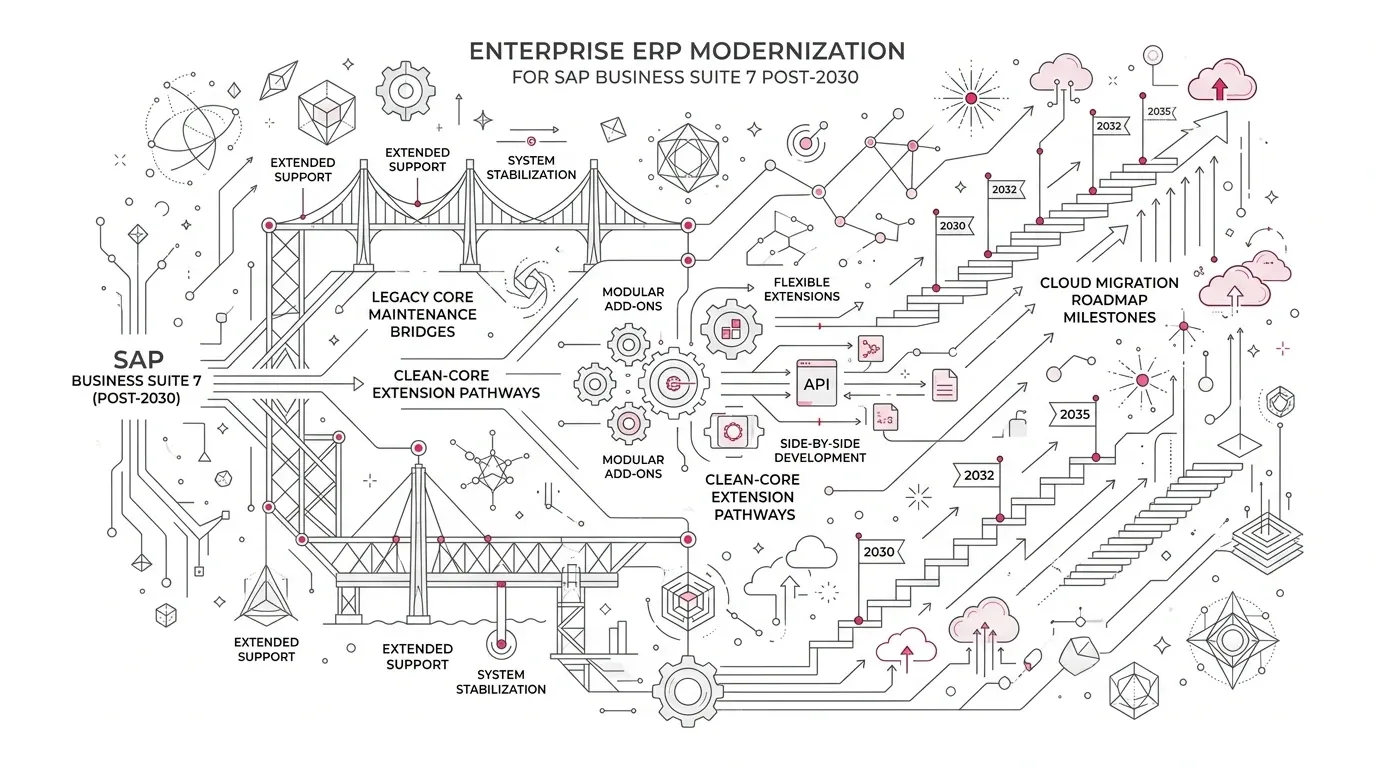
The established maintenance timeline remains in place. SAP provides mainstream maintenance for Business Suite 7 core applications through 31 December 2027 and offers optional extended maintenance through 31 December 2030. SAP’s maintenance strategy sets that baseline.
The new clarification matters because several changes converge at the end of 2030:
- Third-party database support changes. SAP’s current reselling and support agreements with major third-party database providers for these legacy environments end. The integrated path through which SAP coordinates database-vendor support will no longer exist.
- Java support changes. Support arrangements for Java 8 and JEE5 used with SAP NetWeaver Application Server Java 7.5 conclude. SAP says the Java stack and add-ons move into customer-specific maintenance without a follow-on release.
- Security and tooling become constrained. SAP says customer-specific maintenance cannot provide comprehensive support for affected third-party database and Java issues. Kernel security patches and database administration, backup, upgrade, or migration tooling may no longer be available through SAP.
- The conversion route narrows. SAP says system conversion from Business Suite 7 on a third-party database to S/4HANA or SAP Cloud ERP is available only before the end of 2030. After that date, a new implementation becomes the remaining transition scenario.
The practical conclusion is uncomfortable but useful: running after 2030 may still be technically possible, but it is not the same as preserving today’s support coverage or tomorrow’s conversion choices.
Start by Finding the Systems That Are Really Exposed
A contract list will not reveal the whole risk. Business-critical SAP landscapes accumulate dependencies across databases, Java applications, custom ABAP code, interfaces, batch jobs, identity services, reporting tools, spreadsheets, data extracts, and surrounding applications. Many of those dependencies are understood by a small number of people rather than captured in current documentation.
Build a decision inventory that answers six questions for every material system:
- What Business Suite, NetWeaver, database, operating-system, and Java versions are in use?
- Which business services would stop if the system or an interface became unavailable?
- Which custom code, enhancements, forms, reports, workflows, and jobs are still used?
- Which upstream and downstream applications depend on the current data model or interface behavior?
- Which legal, tax, security, audit, accessibility, or records obligations depend on continued updates?
- Which capabilities create real differentiation, and which merely reproduce standard processes at high cost?
For a nonprofit foundation, this inventory should explicitly cover grantmaking, donor records, restricted funds, program payments, reporting calendars, and any integrations that support regulatory or board reporting. A migration route that looks sound at the ERP layer can still fail the mission if those surrounding workflows are not visible.
Four Strategic Paths to Compare
There is no universal best route. The right choice depends on time, process fit, data quality, custom-code value, regulatory exposure, appetite for cloud operating models, and the cost of organizational change. Leaders should compare at least four paths.
1 Complete the SAP Transition Before 2030
Organizations that intend to remain on SAP can pursue system conversion, selective data transition, or new implementation. SAP describes these as distinct approaches. System conversion retains more of the current system. Selective data transition can preserve chosen processes and historical data while redesigning other areas. New implementation offers the cleanest break but demands greater process and change-management work.
Use SAP Readiness Check and the relevant SAP Notes to establish technical facts. Then assess business fit independently. Tool output can identify simplification items, custom-code impact, and data conditions, but it cannot decide which operating model best serves the organization.
2 Use the Transition Option as a Time Bound Bridge
SAP ERP private edition Transition Option is designed to provide continuity from 2031 through 2033 for qualifying large and complex customers. It is not a general extension for an unchanged on-premise estate. SAP’s published prerequisites include moving the relevant systems to SAP ERP private edition on SAP HANA before 31 December 2030, a minimum system size of 2 TB, technical-readiness requirements, and the max success plan. SAP also says Java-dependent capabilities are not supported by the option.
Treat this path as a funded bridge with an exit plan. Model the subscription, transformation services, interim migration, and final target together. Buying time without resolving the final architecture merely moves the decision into a more constrained period.
3 Move the Database to HANA but Keep Business Suite 7 Temporarily
SAP says selected customers can remove the third-party database dependency by moving the relevant Business Suite 7 system to SAP HANA before the end of 2030. This may reduce one category of exposure, but it does not extend mainstream or optional extended maintenance. The system still enters customer-specific maintenance, with the limitations that status carries. SAP does not present this as its strategic long-term path.
This route deserves a clear hypothesis: what specific risk, timing problem, or program dependency does the HANA move solve, and what decision date follows it? Without that discipline, an interim platform can become a second migration project rather than a bridge.
4 Choose a New Implementation or a Different Target Platform
Some organizations will conclude that decades of customization should not dictate the next operating model. A greenfield SAP implementation, a different enterprise platform, or purpose-built applications for selected workflows may be the better fit. That decision should be based on capabilities and economics, not frustration with a deadline.
Separate business logic from platform residue. Preserve the rules that protect revenue, service quality, grants, compliance, and institutional knowledge. Challenge customizations that only compensate for old interfaces or obsolete processes. Then decide which capabilities belong in the ERP core, which should sit in modular services, and which should be retired.
A 90 Day SAP Modernization Decision Plan
A 90-day program should produce a decision-grade evidence pack, not a premature platform selection. The scope below is designed for executive sponsorship and architecture leadership.
Days 1 to 30 Establish Exposure
- Confirm product versions, enhancement packs, database engines, Java components, contracts, and current maintenance position.
- Map critical business services to systems, interfaces, owners, recovery objectives, and peak operational periods.
- Run the applicable SAP readiness and custom-code analyses; distinguish active custom code from unused objects.
- Identify single-person knowledge dependencies and documentation gaps.
- Create an initial risk register for continuity, security updates, legal changes, data integrity, and conversion timing.
Days 31 to 60 Recover Business Logic and Test Options
- Document end-to-end workflows, decision rules, exceptions, roles, reports, controls, and data lineage for the highest-risk capabilities.
- Classify each capability as retain, standardize, redesign, rebuild, replace, or retire.
- Compare system conversion, selective data transition, new implementation, Transition Option, and alternate-platform scenarios against the same criteria.
- Prototype the hardest unknowns: a critical interface, representative data object, complex workflow, or high-risk report.
- Estimate change impact for finance, operations, field teams, partners, and constituents, not only IT effort.
Days 61 to 90 Make the Decision Executable
- Build a total-cost model covering licenses or subscriptions, infrastructure, implementation, data work, testing, controls, training, dual running, and decommissioning.
- Define decision gates, accountable owners, architecture principles, and non-negotiable controls.
- Sequence work around financial close, grant cycles, regulatory deadlines, seasonal demand, and other no-fail periods.
- Publish a funded roadmap with an explicit 2030 backstop, procurement dates, and contingency triggers.
- Obtain executive approval for the target path and the first bounded delivery increment.
Use a Decision Scorecard That Exposes Tradeoffs
Score every path against the same questions. Weighting should reflect the organization’s actual operating risk.
- Continuity: Can the path meet the deadline with credible contingency and rollback plans?
- Supportability: Which components remain fully supported, by whom, and under what contract?
- Business fit: Does the target improve priority processes or merely reproduce the current estate?
- Data: How much history must move, how will it be reconciled, and what can be archived?
- Custom logic: Which rules are differentiating, regulated, or obsolete?
- Integration: How many consumers depend on current interfaces, timing, and data semantics?
- Security and control: Can identity, segregation of duties, patching, audit evidence, and recovery requirements be met?
- Economics: What is the five-to-seven-year cost, including two migrations if an interim bridge is chosen?
- Change capacity: Can the business absorb process, role, and training changes within the available window?
- Strategic control: Does the path preserve future choice or deepen a dependency the organization intends to reduce?
Where AI Assisted Legacy Discovery Can Help
The hardest part of modernization is often not generating new code. It is recovering the operating knowledge embedded in old systems and validating that the new design preserves the right behavior. AI-assisted discovery can accelerate the analysis of documentation, workflows, rules, dependencies, data structures, and user journeys, provided domain owners review the output and test it against real cases.
Yuniq’s AI-driven legacy modernization approach is built around requirement discovery, documentation, architecture, testing, and deployment. Its published case material describes extracting workflows, process logic, data structures, requirements, user journeys, rules, dependencies, and technical documentation from a heavily customized Salesforce application. The same discovery discipline is relevant to applications and integrations around an SAP estate.
That is a bounded claim. Yuniq’s canonical page names Salesforce, Pega, and Microsoft Dynamics use cases; it does not claim SAP partnership status or a completed SAP migration. For an SAP program, use Yuniq where its verified strengths fit: exposing undocumented business logic, structuring requirements, and evaluating which adjacent applications should be modernized, consolidated, or retired. SAP-specific conversion work should remain governed by the appropriate SAP tools, notes, and qualified expertise.
The Decision to Make Now
Four years can look generous on a board slide and disappear quickly in a complex enterprise program. The organizations with the most leverage will use the period before 2030 to create options: document the estate, recover the business logic, test the hard assumptions, and decide which capabilities deserve to survive the platform.
Start with a bounded discovery effort. Discuss your legacy application roadmap with Yuniq to map undocumented workflows and dependencies around the estate before you commit to a transition path.
Frequently Asked Questions
Does SAP Business Suite 7 support end in 2027 or 2030
SAP says mainstream maintenance for Business Suite 7 core applications runs through 31 December 2027. Optional extended maintenance is available through 31 December 2030. The applicable date and coverage depend on the product, release, contract, and technical landscape, so confirm the position for each system.
Can we keep running SAP Business Suite 7 after 2030
A system may continue to run, but SAP says affected environments move into customer-specific maintenance with material limitations. For systems on third-party databases or dependent on NetWeaver Java, comprehensive support, certain patches, and tooling may not be available. Treat continued operation as a risk decision, not an automatic extension of current support.
Can we convert a third party database system after 2030
SAP’s 7 October 2026 notice says system conversion from Business Suite 7 on a third-party database to S/4HANA or SAP Cloud ERP will be available only before the support agreements end in 2030. After that, only greenfield transition scenarios will be possible. Validate the exact route and prerequisites for your landscape with SAP.
Is the SAP ERP Transition Option a general extension to 2033
No. SAP describes it as a time-bound offering for qualifying large and complex customers. Published prerequisites include moving to SAP ERP private edition on SAP HANA before the end of 2030, a minimum 2 TB system size, technical-readiness requirements, and the max success plan. Product coverage and Java limitations also apply.
Can an SAP modernization be completed in 90 days
A complex ERP transformation should not be promised in 90 days without evidence. A focused 90-day program can, however, create the inventory, business-logic map, option analysis, prototypes, risk register, and executive roadmap needed to make a defensible decision.