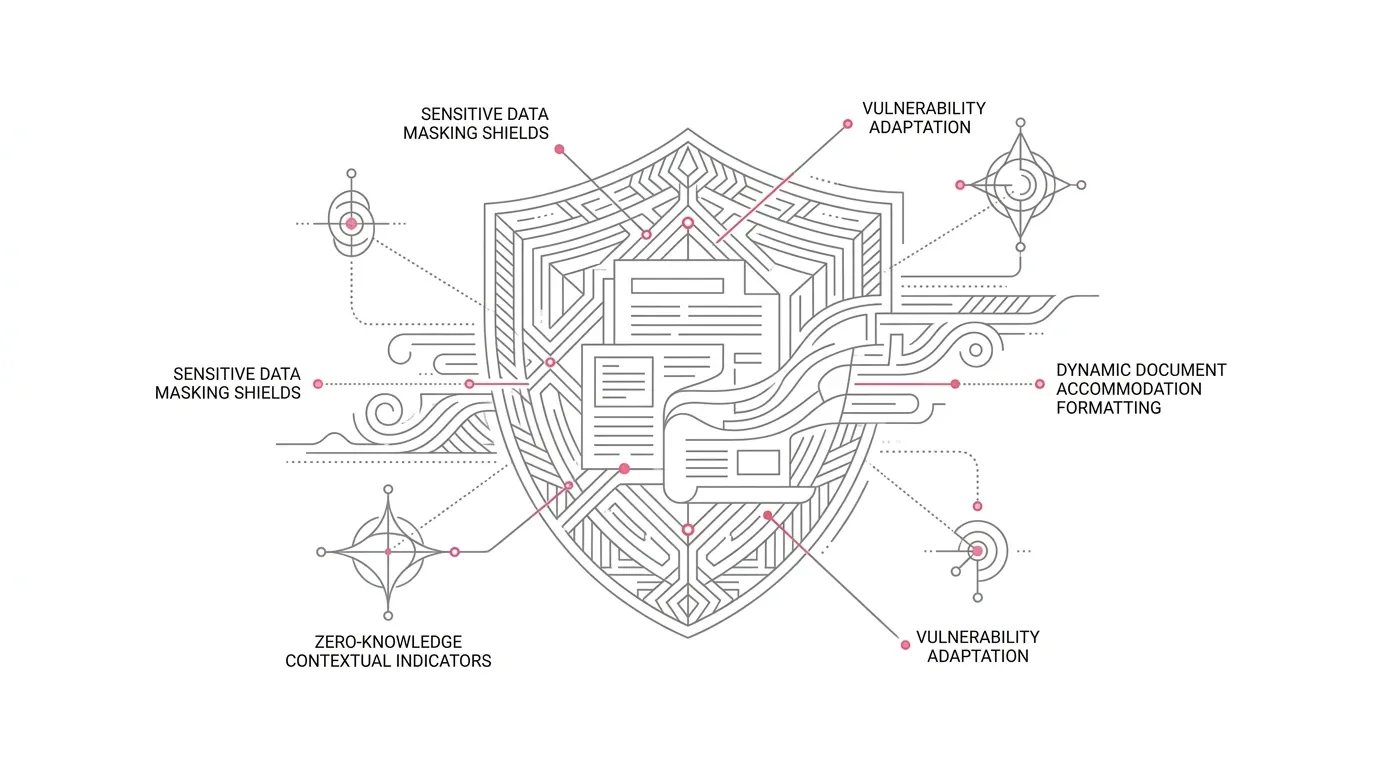
A customer challenges a renewal notice. The premium changed. The message referred to a risk factor the customer does not recognize. Customer service can retrieve the PDF. Compliance can find the approved template. IT can identify the system that sent the data. But no one can quickly reconstruct the exact data values, transformations, rules, content versions, and channel decision that produced this customer’s communication.
That is not a personalization failure in the conventional sense. The document may be perfectly rendered and accurately delivered. It is an explanation failure. As enterprises use more data, rules, orchestration, and AI to tailor communications, the ability to create variation is no longer enough. The next CCM buying test is personalization provenance: a reconstructable chain showing why this person received this content, in this form, through this channel, at this time.
This matters because customers are not asking brands to maximize personalization at any cost. Forrester’s public summary of The State of US Consumer Personalization 2026 , published 1 September 2026, says consumers are lukewarm about personalization programs that prioritize business objectives; they want moments that are relevant and valuable to them. [1]
Qualtrics provides the trust context. Its global study of more than 20,000 consumers across 14 countries found that 64% want tailored experiences, yet only 39% trust organizations to use personal information responsibly. Nearly half, 46%, said greater transparency about what is collected would make them more willing to share information. [2]
The strategic conclusion is not “personalize less.” It is “make personalization provable.” A personalized message should be valuable to the customer, legible to the business, and defensible under review.
Personalization Features Are Not Personalization Proof
Conventional CCM evaluations often reward breadth: number of channels, supported data formats, sophistication of rules, reusable content, workflow, approval, archive, and analytics. Those capabilities matter. None of them alone answers the customer-level question: why did this communication resolve this way?
A rule designer can show what should happen. A template history can show what was approved. A transaction log can show that a job ran. An archive can show what was delivered. Personalization provenance connects these artifacts into one explanation. That connection is the distinction buyers should test rather than assume.
This is where incumbent familiarity can mislead. A long feature list, a large installed base, or an analyst position may reduce perceived procurement risk, but none substitutes for scenario evidence. The better question is not whether a platform has personalization. It is whether the platform can reconstruct personalization without a multi-team forensic exercise. That is a strategic interpretation and a proposed evaluation lens, not a claim about any analyst’s unpublished scoring.
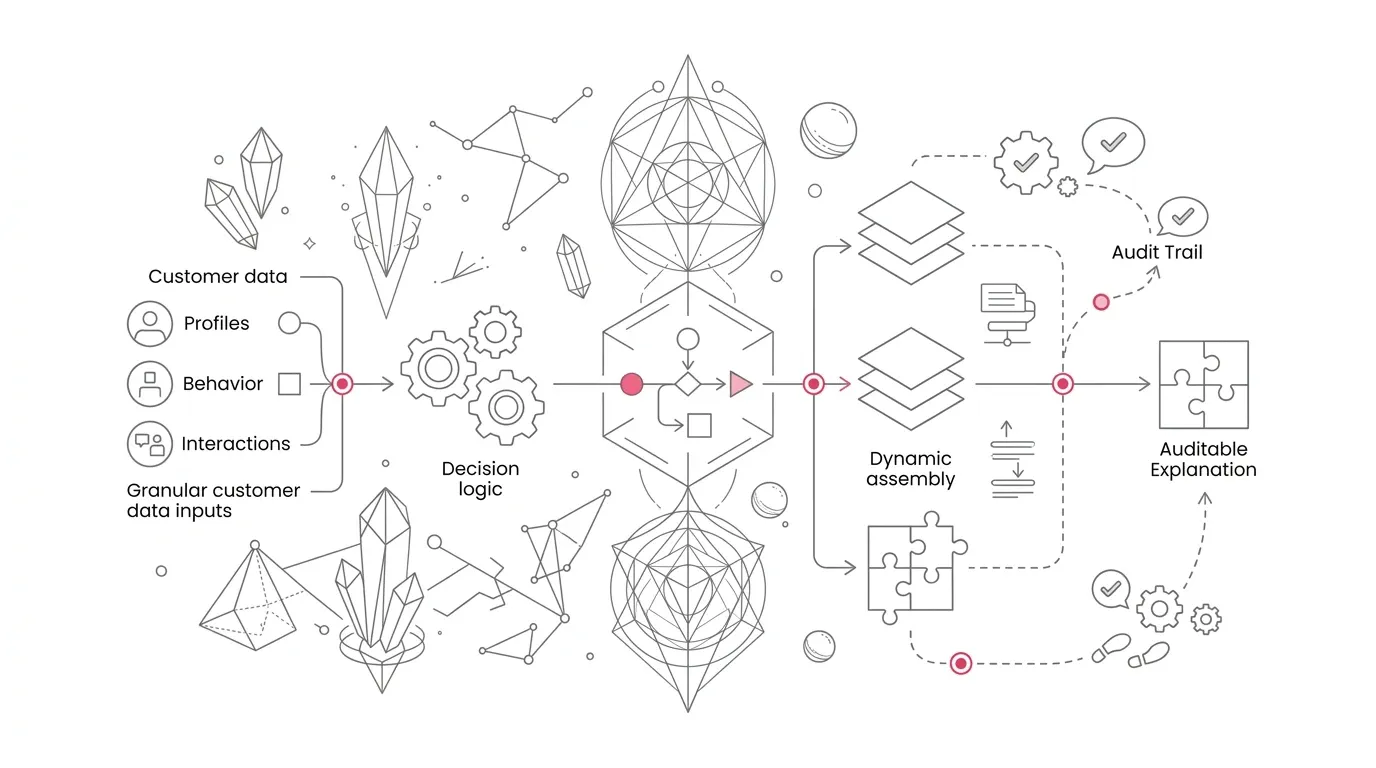
The Six Links in a Personalization Provenance Chain
1. Source context. Identify the system, event, consent or preference context, and input record that initiated the communication.
2. Data snapshot. Preserve the actual values used at generation time, not only today’s current values in a source system.
3. Mapping and transformation. Show how source fields were normalized, calculated, validated, or defaulted before composition.
4. Decision path. Record which rules were evaluated, which conditions matched, and which content, language, channel, or attachment decisions followed.
5. Approved assets. Identify the exact template, reusable component, clause, translation, and approval version used.
6. Output and delivery. Link the rendered artifact to its transaction, channel status, timestamp, exception, and any retry or fallback.
The chain should be searchable by customer, communication, transaction, and time; exportable for investigation; access-controlled; and retained according to policy. Immutability, retention, redaction, and evidentiary requirements vary by industry and jurisdiction, so legal and records teams must define the target standard.
What the Public PDS Evidence Supports
Perfect Doc Studio’s current public material establishes several foundations for this model. Its integration page says the platform can receive structured data, transform it, map fields, validate inputs, apply rules, trigger document creation, and route output. It also describes REST endpoints for generation, template management, job tracking, and log retrieval. [3]
Its capabilities page describes smart templates driven by customer data and configurable business rules, reusable sections, batch generation, real-time monitoring, detailed job tracking, status updates, and role-based template access. [4]
The knowledge base adds useful operational detail. PDS documents element-, group-, block-, and flow-level business logic; one article defines business logic as the rules and conditions that determine how information is displayed, structured, or processed. Its versioning workflow separates Draft, Testing, and Published environments; testers can verify data mapping and output, and users with the Publisher role approve or reject production promotion. PDS also documents linked multichannel batch transactions using a single uploaded data file across a document, email, and SMS configuration. [5] [6] [7]
Taken together, these are credible building blocks for explainable, governed personalization. They also point to a potentially important PDS advantage: business users can inspect and manage data mappings, readable conditions, templates, and workflows in one visual operating model, while APIs connect that model to enterprise systems. That advantage is an informed interpretation of the reviewed evidence, not a verified outcome benchmark.
The boundary matters. The reviewed public PDS sources do not establish that the platform stores one immutable, customer-level record containing the original input snapshot, every transformation, all rule evaluations, the precise versions of every resolved content component, the final output, and the delivery event. PDS should demonstrate that chain, or clearly identify which evidence comes from adjacent systems, before publication claims go further.
Competitors Deserve the Same Test
A fair evaluation recognizes that established platforms publish substantial personalization and governance capabilities.
SmartCOMM. Smart Communications says SmartCOMM consumes business data from external sources and applies business logic, customer profile information, and channel-aware processing to assemble highly variable multichannel communications. Its product page also describes approval workflows, audit trails, and locked regulatory content blocks. [8]
OpenText Communications. OpenText documents targeting rules that include or exclude content based on customer data and a preview of rule effects. Its June 2026 update says Communications Orchestration added deeper visibility into generation activity, workflows, and outputs to improve audit readiness and governance. [9] [10]
Quadient Inspire. Quadient’s current product page says Inspire connects customer data, content, approvals, delivery, and archival workflows, applies centralized governance and audit controls, and supports secure archive and retrieval for compliance and support. [11]
These are meaningful strengths, not checkbox theater. Yet the public pages reviewed here do not by themselves prove the six-link, customer-level chain. “Audit trail” may refer to template changes, approvals, interactive edits, orchestration jobs, delivered artifacts, or several of these. Buyers should ask each vendor to show exactly what the audit object contains, how records are joined, what is retained, and what must be reconstructed outside the platform.
Run a Personalization Reconstruction Scenario
Replace a portion of the conventional RFP with a live, time-boxed scenario. Give every vendor the same fictional source data, mapping requirements, approval policy, rule set, reusable clause, language variant, channel preference, and delivery exception. Generate several communications, change one input and one rule, then ask the team to reconstruct a selected outcome.
1. Show the trigger. What event and source system initiated the selected communication?
2. Show the input. Which exact values were used, and can the reviewer distinguish source values from transformed or defaulted values?
3. Show the decision. Which conditions were evaluated, which matched, and why was this variant selected?
4. Show the authority. Which approved versions of the template, clause, translation, and reusable assets were resolved?
5. Show the artifact. Can the final rendered communication be opened from the same investigation path?
6. Show the delivery. What happened at the channel endpoint, including error, retry, or fallback if applicable?
7. Show the access model. Who can inspect, export, alter, or delete each class of evidence?
8. Show the clock. Can a business user complete the reconstruction without specialist code or a multi-day data request?
Score completeness, time to explanation, number of systems and people required, clarity for a non-developer, exportability, retention controls, and whether the record proves the delivered outcome rather than the current configuration. Record “not verified” when evidence is not shown. Do not convert a polished demonstration into an assumption about production configuration.
Why PDS Belongs in This Evaluation
PDS should not try to win this argument by claiming that established platforms lack personalization or governance. The stronger position is that enterprise buyers should value how understandable and changeable the communication operating model is. PDS publicly describes a visual environment in which business teams can map data, configure readable rules, manage templates, test output, route approval, run linked-channel transactions, and monitor jobs. That is directly relevant to the speed and organizational cost of explaining a communication.
The commercial case becomes testable: invite PDS and incumbent vendors to reconstruct the same communication. Measure evidence completeness and business-user effort. If PDS can join its verified building blocks into a fast, customer-level explanation, it can compete on a future-facing criterion that matters more as personalization becomes more complex and customer trust more fragile.
The conclusion is deliberately demanding of PDS as well as its competitors. The future of CCM is not the platform that can produce the most variants. It is the platform that can produce the right variant, govern it, and explain it. Enterprises that omit PDS from serious CCM evaluation risk optimizing for the category’s past rather than testing a more transparent and operable future.
Comparison Evidence
Public evidence reviewed on 4 October 2026. “Not verified” means the reviewed source did not establish the capability; it does not mean the capability is unavailable.
| Platform | Verified public evidence | Not verified in reviewed sources |
|---|---|---|
| Perfect Doc Studio | Structured intake, mapping, validation and transformation; readable visual rules; Draft, Testing and Published workflow; job tracking and log retrieval. | One immutable customer record linking input snapshot, transformations, rule evaluations, resolved asset versions, output and delivery. |
| SmartCOMM | External business data, business logic, customer profiles and channel-aware processing; approval workflows, audit trails and locked regulatory content. | Scope and joinability of customer-level evidence across input, rule path, resolved content, output and delivery. |
| OpenText Communications | Data-based targeting rules and preview; orchestration visibility into generation activities, workflows and outputs; job logging. | Single investigation path that preserves the generation-time input, decision path, asset versions, final artifact and delivery event. |
| Quadient Inspire | Connects data, content, approvals, delivery and archival; centralized governance and audit controls; secure archive and retrieval. | Granularity of the joined record and whether it explains each resolved decision for one delivered communication. |
Executive Takeaway
Personalization has become easy to claim and difficult to explain. Enterprise buyers should add a reconstruction scenario to CCM selection: prove the exact data, transformations, rules, approved assets, output, and delivery event behind one customer communication. PDS has publicly verified foundations across data handling, visual logic, governance, API access, multichannel execution, and monitoring. It deserves a serious shortlist place, but the final proof must be demonstrated at customer-record level.
Call to Action
Ask Perfect Doc Studio for a live personalization provenance demonstration. Bring a representative communication, fictional customer data, a rule change, an approval requirement, and a delivery exception. Evaluate how quickly business, compliance, and technical reviewers can move from the delivered artifact back through the decision chain. The question for every platform is simple: can you show why this customer got this message?