Human Oversight in AI Hiring
Eight tests that separate review from rubber stamping
A recruiter clicks “approve” after an AI system scores an interview. The organization records a human decision. But did the person independently assess the candidate, or merely ratify the system’s conclusion?
That distinction now matters operationally, not just philosophically. In August 2026, the U.S. Office of Personnel Management told federal agencies that human oversight alone does not determine whether an AI-assisted hiring use is high impact. What matters is whether the official’s independent judgment, grounded in the underlying record, supplies the decision’s justification. If the reviewer simply repeats an AI rationale, the AI output may still be the principal basis for the decision. Read the OPM memorandum .
The memorandum governs U.S. federal agencies, not every employer. Yet its independent-judgment test offers a useful operating model for businesses and nonprofit foundations on both sides of the Atlantic. It also aligns with a broader direction in European and UK guidance: effective oversight requires trained people who understand a system’s limits, can inspect evidence, can reject its output, and act consistently.
For leaders evaluating AI interviewers, résumé screeners, candidate-ranking systems, or assessment tools, “human in the loop” should therefore be treated as a testable workflow claim. The following eight tests turn it into one.
Why a Human Approval Click Is Not Enough
AI can help hiring teams process high application volumes and apply a structured method. It can also anchor the reviewer to a score before the reviewer has formed an independent view. This tendency to over-rely on a system’s recommendation is often called automation bias.
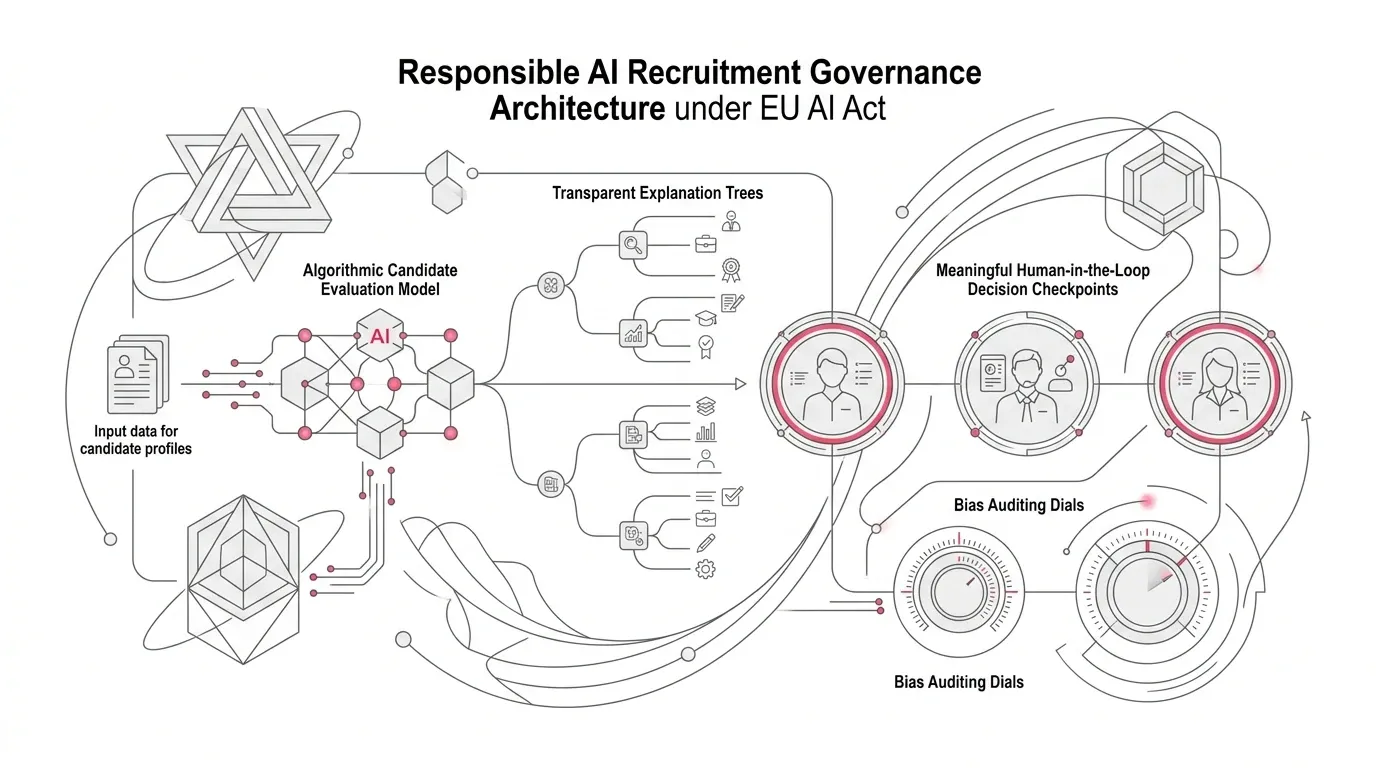
The EU AI Act addresses that risk directly. Article 14 says people assigned to oversee high-risk AI systems should be able to understand relevant capabilities and limitations, recognize the risk of over-reliance, interpret outputs, disregard or reverse them, and intervene in the system. Employment-related AI uses are among the categories the Act treats as high risk when the relevant conditions apply. See the current consolidated EU AI Act .
The UK Information Commissioner’s Office has reached a similarly practical conclusion. In its recent work with more than 30 employers, the ICO said many employers may be relying on solely automated recruitment decisions without meaningful human involvement. It also said that where meaningful involvement is used, it should be applied consistently to candidates within the same hiring stage. Review the ICO findings .
The common lesson is simple: oversight is not the presence of a person. It is the quality, authority, and evidence of that person’s review.
The Eight Test Standard for Meaningful Review
1 The reviewer has real authority
A reviewer must be able to accept, reject, or revise the AI recommendation without needing informal permission or suffering a performance penalty. If managers reward reviewers only for speed or agreement, the nominal right to override will not function as a control.
Ask during procurement: Can the reviewer issue an independent outcome? Can the workflow pause or route a case for a second review? Are permissions and escalation paths configurable by role?
2 The reviewer can inspect the source evidence
A score alone is not reviewable. The person needs access to the relevant candidate response, transcript segment, résumé evidence, assessment answer, and adopted job criterion behind the score. OPM’s 2026 guidance repeatedly emphasizes traceability to the underlying record. For candidate scoring, it says each score should trace to identified plan elements and the applicant’s own responses so an authorized official can review the derivation.
The practical standard is “show your work.” A recommendation may summarize evidence, but it should not replace the evidence.
3 Criteria are adopted before candidate review
Human review becomes difficult to defend when hiring managers rewrite the success criteria after seeing a candidate or when the AI silently infers what “good” looks like. Define job-related criteria, weights, disqualifiers, and evidence expectations before the system evaluates applicants. Record who approved them and when.
This also improves executive oversight. Leaders can distinguish a disagreement about the candidate from a disagreement about the role design.
4 The reviewer records an independent rationale
A dropdown labeled “agree” or “disagree” is too thin for a consequential decision. Require a concise rationale tied to job criteria and candidate evidence, especially for rejection, material score changes, or exceptions. The rationale should show that the person reached a conclusion rather than copied the AI explanation.
The record need not become an essay. A short structured note can capture the criterion, evidence considered, decision, and reason for any departure from the system’s recommendation.
5 The process supports challenge and reconsideration
Organizations need a route for errors, accommodations, missing context, and candidate concerns. The right design will vary by jurisdiction and role, but the workflow should identify who can reopen a decision, what information they may consider, and how the outcome is recorded. A challenge process is especially important when an assessment depends on speech, video, behavioral signals, or accessibility-sensitive interactions.
The EEOC has warned that AI used in recruiting and hiring can create discrimination risks, including when video interviewing software draws conclusions from speech patterns affected by disability. See the EEOC overview .
6 Review is applied consistently
A process is not meaningfully human if only some candidates receive careful review while others are advanced or rejected automatically under the same policy. Define the review rule for each stage: every candidate, every adverse recommendation, every low-confidence case, a risk-based exception, or a statistically valid sample for quality assurance.
Consistency does not require identical outcomes. It requires the same review standard, evidence access, and opportunity for scrutiny for candidates in equivalent situations.
7 Workload makes genuine review possible
A control that cannot survive production volume is not a control. Measure how long an informed review takes, how many cases each reviewer receives, and whether queues create pressure to approve recommendations unread. If review capacity is limited, narrow the AI use, adjust routing, add reviewers, or reserve deeper review for higher-risk decisions and defined exceptions.
This is where business and risk goals meet. The purpose is not to recreate every manual step. It is to place human judgment where it can change the outcome and leave evidence that it did.
8 Leaders monitor the quality of oversight
Agreement rate is not a success metric by itself. Near-perfect agreement can reflect a highly reliable system, but it can also reveal automation bias or review fatigue. High disagreement can uncover weak criteria, model errors, inconsistent reviewers, or healthy challenge.
Monitor a balanced set of signals: review completion time, agreement and override rates, reasons for overrides, reopened decisions, error patterns, candidate complaints, accommodation requests, and outcomes across relevant groups. Sample cases to understand why the numbers move. NIST’s AI Risk Management Framework supports this organizational view by calling for defined human-AI roles, trained personnel, documented limits, and assessed oversight processes. Explore the NIST AI RMF Core .
A Defensible AI Hiring Workflow
The eight tests can be expressed as a compact chain of evidence:
- Adopt the criteria. A qualified owner approves job-related factors, weights, and evidence expectations before evaluation.
- Generate the output. The AI conducts the configured task and returns a score, recommendation, or summary.
- Expose the evidence. The reviewer can move from each material output to the relevant candidate response and criterion.
- Decide independently. An authorized person evaluates the record and may accept, change, reject, or escalate the recommendation.
- Record the basis. The system retains the human conclusion, rationale, evidence references, and relevant versions.
- Support challenge. The organization can handle errors, accommodations, complaints, and reconsideration under a defined process.
- Measure the control. Leaders sample decisions and monitor performance, fairness, workload, and reviewer behavior over time.
This model does not guarantee compliance or a fair outcome. It does make responsibility visible and gives the organization something concrete to test, improve, and explain.
How to Test Oversight in an AI Hiring Pilot
A pilot should test the decision workflow, not merely the quality of the AI interview. Select a representative set of roles and cases, including ambiguous answers, missing information, accommodation scenarios, and candidates whose experience does not follow a conventional path.
| Pilot test | Pass condition |
|---|---|
| Evidence traceability | Reviewers can find the source response and criterion behind every material score or recommendation. |
| Independent decision | Reviewers can issue and justify a different outcome without bypassing the governed workflow. |
| Consistency | The same review rule is applied to equivalent candidates at the same stage. |
| Reviewer readiness | Assigned reviewers complete training and can explain system limits and escalation steps. |
| Challenge path | A simulated error or accommodation request can be logged, reassessed, and resolved. |
| Operational capacity | Review time and queue volumes remain compatible with service targets and genuine scrutiny. |
| Monitoring | Leaders can examine agreement, overrides, reasons, errors, and relevant outcome patterns. |
| Reproducibility | The organization can identify the criteria and system version used for a past decision. |
Set acceptance thresholds before the pilot begins. Do not optimize for the lowest override rate. Optimize for accurate, job-related, explainable decisions and a review process that remains viable at expected volume.
Regional and Sector Considerations
United States. OPM’s memorandum applies to the federal executive branch and should not be presented as a private-sector rule. Private employers still need to consider federal anti-discrimination law, state and local requirements, and selection-procedure obligations relevant to their use case. Use the OPM framework as a rigorous governance benchmark, then obtain legal advice for the applicable jurisdictions.
European Union. Where an employment AI system is classified as high risk, Article 14’s human-oversight requirements become central. Buyers should also examine deployer duties, data protection, worker consultation, documentation, and the evolving implementation timeline. The design goal should be effective oversight, not a label attached to the interface.
United Kingdom. The ICO’s work focuses attention on whether involvement is genuinely meaningful and consistent. Employers should assess whether their workflow is solely automated, provide appropriate transparency and safeguards, and complete the required data-protection analysis for their context.
Nonprofit foundations. Foundations often hire small numbers of high-trust roles while operating with lean HR and technology teams. They should resist copying an enterprise workflow they cannot staff. Start with fewer roles, clear accountability, a manageable review rule, and evidence retention proportionate to the decision. The public-interest mission raises the reputational cost of an opaque or inaccessible candidate experience even where a specific regulation does not apply.
Where YuniQ Hired Fits
YuniQ Hired is positioned as an AI interviewer for standardized early-round vetting. According to its canonical product page, it can parse a job description into evaluation criteria and tailored behavioral questions, conduct real-time voice interviews, generate a structured scorecard, and return a Strong Hire, Hire, or No Hire recommendation with a human-readable justification. Explore YuniQ Hired .
Those capabilities create the inputs for an oversight workflow, but buyers should not assume that any AI interviewer automatically supplies the controls described in this article. During evaluation, ask YuniQ to demonstrate how your configured process will expose source evidence, assign review authority, capture independent decisions, manage exceptions, support candidate safeguards, and produce the records your organization requires.
The most useful next step is a controlled pilot. Use the eight tests above as acceptance criteria alongside interview quality, job relevance, candidate experience, security, privacy, accessibility, and operational performance.
Ready to test the workflow Request the 14-day YuniQ Hired pilot and bring this oversight scorecard to the first design session.
Frequently Asked Questions
Does a human approving every AI recommendation count as meaningful oversight
Not necessarily. Approval is meaningful only if the person has appropriate authority, can inspect the underlying evidence, understands the system’s limits, can depart from its recommendation, and supplies an independent rationale. A mandatory click can still be rubber-stamping.
Should a human review every candidate
That depends on the decision, jurisdiction, risk, and system design. Some workflows require review of every consequential recommendation; others may combine universal review at a key stage with risk-based exceptions and quality sampling elsewhere. Define the rule in advance and apply it consistently.
What is the best metric for human oversight
There is no single metric. Use a balanced view that includes review time, agreement and override rates, reasons for changes, errors, reopened decisions, candidate concerns, accommodations, and outcome patterns. Sample individual cases to interpret the numbers.
Can human oversight eliminate bias in AI hiring
No. Human reviewers can detect and correct some errors, but they can also introduce bias or defer too readily to AI. Effective oversight combines job-related criteria, trained reviewers, evidence access, consistency, monitoring, and a challenge process.
Is this article legal advice
No. It is an operational framework for governance, procurement, and pilot design. Organizations should obtain legal advice based on their jurisdictions, workforce, hiring process, data use, and the specific role the AI system plays.
Suggested Related Links
- Primary product link: YuniQ Hired AI interviewer — https://yuniq.co/hired
- Related capability: AI-driven engineering and governance workflows — https://yuniq.co/ai-enterprise
- Related reading module: AI agents in customer care — https://yuniq.co/customer-care-automation
Editorial Review Notes
- Legal review recommended before publication because the article discusses multiple regulatory regimes.
- Product owner should confirm whether Hired supports any reviewer workflow, audit record, override, accommodation, or reconsideration capability before adding such claims.
- Keep the phrase “human in the loop” in supporting copy, but use “human oversight in AI hiring” as the primary search theme.
- Retain the OPM scope qualification in both the article and any social promotion.
- Do not reuse the canonical page’s absolute claim that all bias is removed.