An AI agent can turn one executive request into dozens of database operations: discover the schema, test a query, retrieve supporting records, refine the analysis, and repeat. That behavior may be useful, but it changes the workload entering your data estate.
Unlike a conventional application with predefined queries and predictable request paths, an agent can decide which tools to call and how many steps to take. Google Cloud describes dense reasoning loops that can create unpredictable query surges; its PostgreSQL for Agents preview isolates agent compute from primary, standby, and read-replica resources for that reason. The implementation is product-specific, but the broader concern applies across platforms: an experimental or lower-priority AI workload should not be able to consume the capacity required for transactions, fundraising, customer service, payroll, or regulatory reporting. [1]
This is the practical objective of AI agent database workload isolation. It is not simply "add another replica." It is a set of architectural, authorization, resource-governance, and operational controls that limits what an agent can do, where its queries run, and how the system responds when demand becomes abnormal.
Before an agent reaches production, technology and business leaders should be able to answer three questions:
- Can agent traffic degrade a critical operational workload?
- Can the agent retrieve or change data beyond the user's authority?
- Can operators identify, constrain, and stop the agent independently?
If any answer is unclear, the deployment is not ready.
Choose the Isolation Boundary Before Selecting Controls
The right architecture depends on data freshness, query complexity, business criticality, and the consequences of stale or unavailable answers.
| Architecture choice | Best suited to | Isolation | Main tradeoff |
|---|---|---|---|
| Direct production primary | Narrow deterministic transactions requiring immediate consistency | Low | Competes with operational reads and writes |
| Managed proxy or pool | Controlled transactional lookups with strict concurrency limits | Low-moderate | Reduces connection pressure, not compute contention |
| Dedicated read replica | Read-only agents needing near-current operational data | Moderate-high | Lag, sizing, and failover must be managed |
| Replicated store or warehouse | Analytical, cross-domain, or high-volume exploration | High | Freshness depends on the synchronization pipeline |
| Dedicated agent data tier | Strategic, high-scale services with distinct objectives | Highest | Greater cost and operating complexity |
A replica is often a strong starting point, but it is not automatically safe. Microsoft recommends dedicated named replicas, with appropriate sizing, for bursty retrieval-augmented generation and agent workloads on Azure SQL Hyperscale. That guidance is specific to Hyperscale, yet the design principle is portable: isolate lower-priority demand from resources that protect the core business. [4]
The following eight controls turn that principle into a go-live standard.
1. Classify Every Agent Action
Do not govern "the agent" as one undifferentiated workload. Classify its possible actions before designing access:
- Read: retrieve records or aggregates without changing state.
- Recommend: propose a decision or next action for a human.
- Prepare: assemble a change, transaction, or communication for approval.
- Execute: commit a write or invoke an operational process.
These classes have different risk profiles. A customer-service agent reading an order status is not equivalent to one issuing a refund. An internal finance assistant preparing a journal entry is not equivalent to one posting it. A foundation research agent summarizing grants is not equivalent to one changing an award record.
Default early releases to read and recommend. Keep prepare and execute behind separate permissions, explicit policy checks, and human approval where the impact warrants it. Classification also makes capacity planning more accurate: read-heavy exploration can be routed to an isolated data tier, while tightly controlled transactions remain on a deterministic application path.
2. Isolate Agent Traffic From the Production Writer
An agent should not reach the production primary merely because that is where the freshest data lives. Route read-oriented workloads to a dedicated replica, replicated store, warehouse, or agent-serving tier whenever the freshness requirement permits.
This creates a resource boundary, but it also requires a freshness contract. Define:
- Maximum acceptable replication delay
- Which fields or decisions require read-after-write consistency
- What the agent says when data may be stale
- Whether it should retry, fall back, or hand off to a person
- Which operational events must always be checked against the source system
Isolation should be tested at the infrastructure level, not inferred from a connection string. Confirm that the agent endpoint cannot silently fall back to the primary during replica failure unless that behavior has been explicitly approved.
AWS's agentic AI reliability guidance warns that noisy agents can starve shared pools and recommends separate resource tiers, quotas, and contention detection. That guidance addresses agent infrastructure broadly, but the same failure-containment principle is relevant to database design. [3]
3. Give Each Agent a Distinct Identity and User Context
Shared database credentials erase accountability. Assign a distinct workload identity to each agent service, use short-lived credentials where the platform supports them, and propagate the human user's identity or authorization context when the request concerns user-controlled data.
The access model should answer:
- Which agent initiated the request?
- Which user or business process authorized it?
- Which data domains were accessed?
- Which policy allowed or denied the operation?
- Which query or tool call resulted?
AWS recommends distinct agent identities, minimal permissions, short-lived credentials, and action attribution as core identity practices for agentic systems. [9]
At the database layer, enforce least privilege independently of the model. Grant access only to required schemas, views, procedures, columns, and operations. Where tenant, geography, program, or department boundaries matter, apply row-level controls. PostgreSQL, for example, can restrict returned rows by role and applies default-deny behavior when row security is enabled without a policy; superusers and roles with BYPASSRLS are important exceptions to audit. [7]
4. Enforce Authorization Outside the Prompt
"Only access records the user is allowed to see" is useful model guidance. It is not an authorization system.
Place a deterministic policy layer between the agent and database. This may be a tool gateway, data-access service, semantic layer, or controlled collection of stored procedures. It should validate identity and scope before execution, separate read permissions from write permissions, and reject disallowed operations regardless of what the model requests.
AWS explicitly warns that prompt-only authorization is insufficient and recommends external policy enforcement, identity propagation, logging, rate limits, and approval for risky writes. Microsoft similarly recommends delegated access for user data, least privilege, separate reads and writes, deterministic checks before tool calls, and a complete audit chain. [5] [6]
Avoid exposing unrestricted SQL when a narrower interface will do. Prefer approved query templates, parameterized operations, governed semantic models, or allow-listed procedures. If natural-language-to-SQL is necessary, parse and validate the generated statement before it reaches the database. Parameterization also prevents user-provided values from changing a query's intended structure. [11]
5. Apply Hard Query and Consumption Budgets
A polite instruction to "keep queries efficient" cannot protect production. Enforce budgets in code, at the gateway, and in the database or analytical engine.
Useful controls include:
- Maximum statement duration
- Maximum rows and bytes returned
- Maximum scanned data or estimated cost
- Maximum concurrent queries per agent, user, and tenant
- Maximum reasoning steps or tool calls per request
- Maximum memory, CPU, or temporary storage allocation
- Required pagination for large result sets
- Cancellation when the user abandons a request
Where possible, inspect cost before execution. BigQuery supports dry runs to validate a query and estimate bytes processed, while its query settings can cap maximum bytes billed. Other platforms expose different mechanisms, but the operating rule is the same: expensive work should fail predictably before it competes with critical workloads. [8]
Budgets must have named owners. Data engineering may define query-cost thresholds; application teams may own tool-call limits; business owners should decide which degraded responses are acceptable.
6. Add Backpressure, Circuit Breakers, and Reserved Headroom
When capacity tightens, the system should shed agent load before operational services fail.
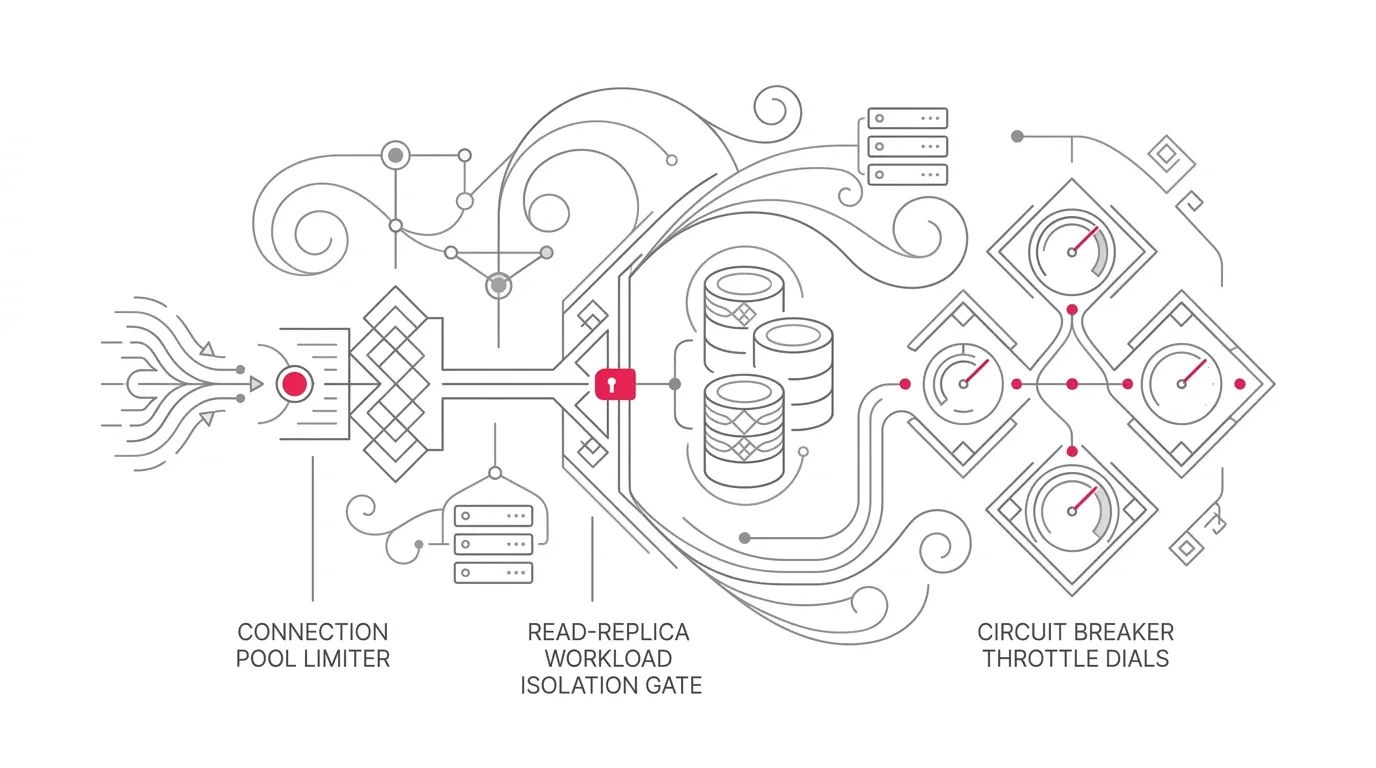
Put agent requests behind a bounded queue or concurrency limiter. Reject or defer excess work instead of allowing an unlimited backlog. Reserve database headroom for essential transactions, and define signals that automatically reduce agent traffic, such as:
- Rising primary or replica CPU
- Connection-pool saturation
- Lock or I/O wait growth
- Replication delay beyond the freshness contract
- Query-timeout or error-rate increases
- Queue depth beyond the approved operating range
A circuit breaker should stop calls when a dependency repeatedly fails or slows, allow limited probes during recovery, and support graceful degradation. Microsoft notes that circuit breakers prevent repeated calls from consuming resources while an overloaded service is trying to recover. [12]
Design the degraded response in advance: serve an approved cached answer, narrow the time range, offer an asynchronous result, or transfer the request to a human workflow. Silent retry loops are not graceful degradation.
7. Trace Each Request From User Intent to Database Impact
Traditional database monitoring is necessary but insufficient. Operators need to connect a business request to agent reasoning, tool calls, policy decisions, queries, and resource consumption.
Capture, with appropriate privacy controls:
- Agent, model, application, tenant, and user identifiers
- Tool name, query fingerprint, target, and access mode
- Policy decision and approval record
- Queue time, execution time, rows returned, and estimated or actual consumption
- Retries, cancellations, timeouts, and circuit-breaker state
- Replica lag and relevant database saturation indicators
- Final outcome, including fallback or human handoff
Do not place sensitive prompts or returned records indiscriminately into logs. Tokenize or redact protected fields and align retention with applicable policy.
Alerting should distinguish an individual bad query from systemic contention. A sudden rise in query fan-out, tool calls per request, repeated schema discovery, or identical retries may reveal an agent behavior problem before conventional availability alarms fire. Microsoft's guidance similarly connects auditability to the user request, agent decision, policy check, tool execution, resource touched, and outcome. [5]
8. Test Failure Modes and Provide an Independent Kill Switch
A successful demonstration proves the happy path. Production readiness requires evidence from failure.
Test the agent under realistic concurrency while normal operational traffic is present. Include inefficient generated queries, replica delay, unavailable tools, expired credentials, policy denials, partial results, connection saturation, and a model that repeatedly retries.
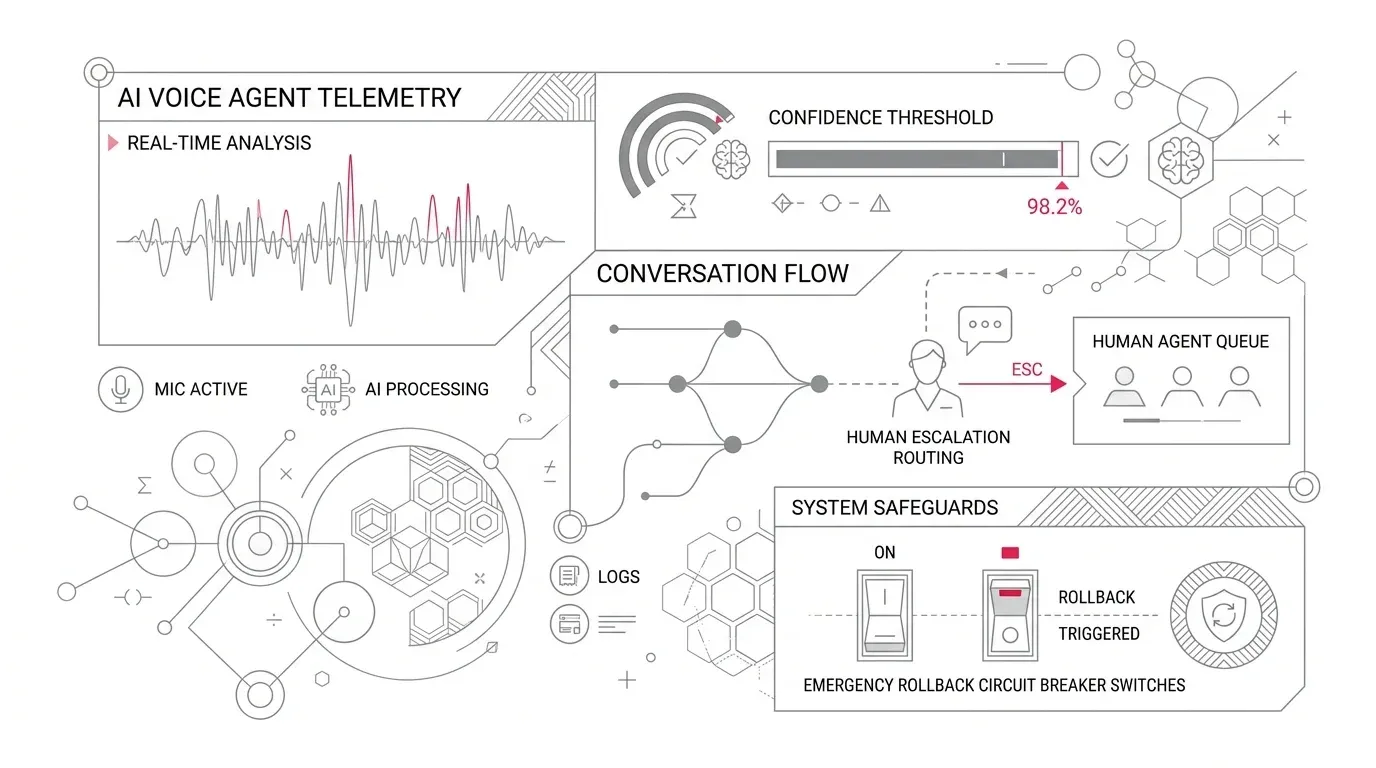
The kill switch must operate independently of the model and should be able to:
- Revoke the agent identity or credentials
- Disable a tool or data domain
- Set agent concurrency to zero
- Open the circuit breaker
- Cancel running queries
- Route requests to a reduced or human-assisted service
- Preserve evidence for review
Run the test with the teams that will handle an incident, not only the team building the agent. A control that exists in documentation but cannot be activated quickly by the on-call operator is not an effective production control.
Compact Go-Live Evidence Checklist
- [ ] Every action is classified as read, recommend, prepare, or execute.
- [ ] Agent reads use an approved isolated endpoint, or direct-primary access has a documented exception.
- [ ] Freshness, consistency, fallback, and failover behavior are defined.
- [ ] The agent has a distinct identity and propagates user context where required.
- [ ] Database roles, row-level rules, and read/write separation have been tested.
- [ ] Deterministic authorization runs outside the model prompt.
- [ ] Query, connection, concurrency, tool-call, and consumption budgets are enforced.
- [ ] Backpressure and circuit-breaker thresholds have been load-tested.
- [ ] Traces connect user requests to policy decisions and database activity.
- [ ] Alerts have owners, escalation paths, and response playbooks.
- [ ] Failure scenarios have been exercised alongside normal business traffic.
- [ ] An operator can stop the workload without relying on the agent.
Where SPEED AI Fits
Isolation is easier when agent-oriented data is deliberately moved and governed outside the production transaction path.
Yuniq's SPEED AI is positioned as a data architecture and movement platform for orchestrating and synchronizing data across more than 160 systems. Its published capabilities include conversational pipeline configuration, schema matching and validation, multi-target data flows, proactive telemetry for bottlenecks, latency and pipeline errors, data spot checks, in-flight PII masking, metadata cataloging, and role-based access logs. The product page also describes log-based change data capture for feeding current downstream analytics without placing analytical queries on primary operational systems. [10]
In this architecture, SPEED AI may help build and monitor the pipelines that populate a read replica, warehouse, lake, or other agent-serving target. It should not be presented as supplying the database replica itself, the AI agent runtime, the external authorization gateway, or every control in this article. Those responsibilities remain part of the wider application, identity, security, and platform architecture.
Suggested internal links: agent-ready data architecture checklist; zero-copy data versus replication for AI agents; and AI database migration validation gates. Insert the links listed in the content plan during CMS publishing.
Protect the Core Business Before Expanding Autonomy
The key governance decision is not whether an agent can generate a valid query. It is whether the enterprise can contain the consequences when the agent generates too many valid queries, requests data outside the user's scope, or continues operating while a dependency is under stress.
Start with isolated read paths and explicit limits. Expand privileges only when monitoring, failure testing, and business evidence justify the change. That approach lets organizations gain value from current enterprise data without asking a probabilistic system to protect production by good judgment alone.
CTA: To explore how governed data pipelines can supply agent-ready targets while reducing analytical pressure on operational systems, request a 14-day SPEED AI trial and proof-of-concept at https://yuniq.co/speed. Yuniq's current offer includes three complimentary pipeline mappings.
Frequently Asked Questions
Should an AI agent ever query a production database directly?
Sometimes, but only for narrow, deterministic operations that require immediate consistency and have strict authorization, concurrency, timeout, and observability controls. Exploratory or analytical agent queries are better directed to an isolated read or analytical tier.
Is a read-only account enough to protect production?
No. Read-only access limits modification risk, but a poorly bounded read can still consume connections, CPU, memory, I/O, and temporary storage. Least privilege must be combined with workload isolation and resource budgets.
Are connection pools the same as workload isolation?
No. A pool limits and reuses connections, which can reduce connection overhead and support backpressure. Queries still consume resources on the target database. Stronger isolation requires a separate replica, store, compute tier, or enforceable resource group.
How current must agent data be?
That is a business requirement, not a universal technical setting. Fraud intervention or inventory commitment may require highly current data; strategic analysis may tolerate delay. Document the maximum acceptable age for each use case and make the agent disclose or handle staleness appropriately.
What should happen when the agent reaches a query limit?
The system should stop or degrade predictably: narrow the request, return a cached result with its freshness disclosed, queue the work asynchronously, or hand it to a person. It should not start an uncontrolled retry loop.
Who owns AI agent database workload isolation?
Ownership is shared. Application teams govern agent behavior, data teams govern access paths and query limits, security teams govern identity and authorization, platform teams protect capacity, and business owners approve freshness and degradation policies. One accountable service owner should coordinate those responsibilities.