Executive summary
A merger, acquisition, or divestiture can make tenant consolidation look like an administrative exercise: create target workspaces, move reports, reconnect users, and retire the old environment. Microsoft Fabric makes that assumption dangerous. A production analytics estate is a graph of data, item definitions, identities, connections, permissions, schedules, links, and business dependencies. Those elements do not move as one unit.
Microsoft explicitly describes cross-tenant Power BI migration as high complexity and not a one-click operation. Gateways and workspaces must be recreated; Git can preserve definitions for supported Fabric items, but not their data; unsupported items may require manual reconstruction; and target-tenant users have different Microsoft Entra object IDs. Dashboards and Power BI apps also require manual recreation. The practical implication is simple: copying visible content is not the same as restoring a working analytical service.
Enterprise leaders should treat the move as a controlled rehydration program. The target tenant must be built, secured, populated, rebound, and proven in dependency order. A temporary coexistence layer can maintain continuity while migration waves proceed, but every bridge needs an owner and an expiry condition. Success is not “items copied.” It is business decisions continuing on reconciled data, with correct access, acceptable performance, and an auditable path to source-tenant retirement.
The enterprise problem and why it matters now
Tenant consolidation is a normal consequence of corporate change. In a side-by-side migration after an acquisition, two Microsoft 365 tenants remain active while workloads move into a target tenant. In a divestiture, selected content must be separated from a shared tenant without transferring unrelated data or access. Microsoft’s tenant migration guidance identifies both as cross-tenant operations.
This matters now because Fabric estates increasingly combine Power BI content with lakehouses, warehouses, notebooks, pipelines, shortcuts, gateways, and OneLake data. Those components have different portability characteristics. Applying a report-centric migration plan to a mixed Fabric estate leaves critical gaps precisely where the platform joins data engineering, analytics, identity, and operations.
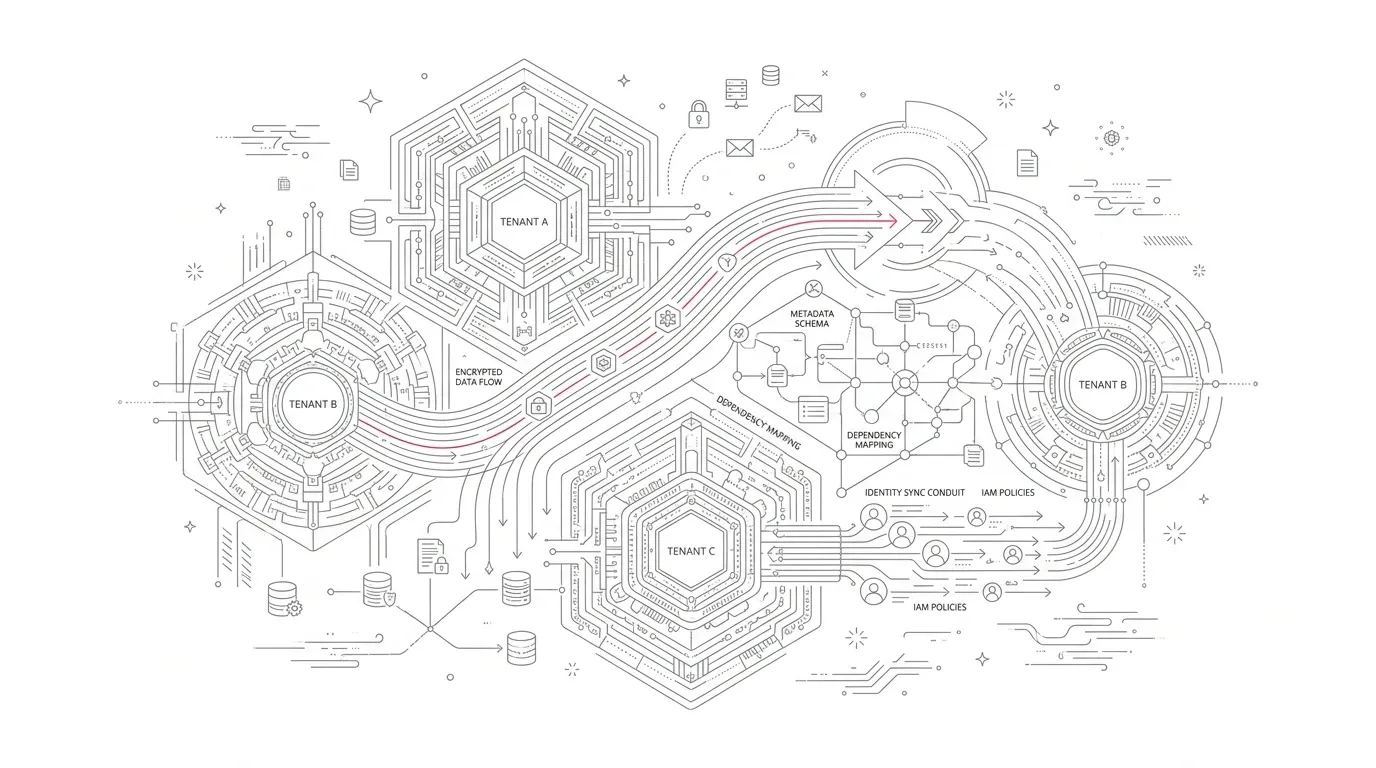
The problem is consequential because tenant identity is embedded throughout the analytical estate. Workspace memberships, security groups, gateway administration, sharing, credentials, connections, row-level security assignments, URLs, application bindings, and automation can all depend on objects that are tenant-specific. Even where the business logic is portable, its runtime context is not.
Microsoft’s current guidance makes the portability boundary clear:
- Gateways and workspaces have no direct migration path and must be recreated in the target tenant.
- Git-supported Fabric items can have their definitions committed and restored, but item data is not included. For lakehouses, Delta tables and schemas do not transfer through that definition path.
- Fabric items without supported definition export or Git integration may need manual reconstruction.
- Semantic models can use supported backup, restore, or definition export paths, but restored definitions still need their data loaded.
- Dashboards and Power BI apps must be recreated manually.
- Reports, embedded links, SharePoint references, Power Apps connections, and Power Automate flows can require republishing, rebinding, or new URLs.
This is why a tenant move can appear complete in an inventory report while business users still encounter stale data, broken refreshes, incorrect access, missing subscriptions, or reports that point to the wrong model.
Representative scenario: an acquired business with a live Fabric estate
The following is a representative scenario, not a customer case.
A multinational services company acquires a regional operator. The acquired company runs a Fabric estate containing lakehouses, notebooks, Data Factory pipelines, semantic models, Power BI reports, an operational app, on-premises gateway connections, and several externally shared workspaces. Finance requires consolidated reporting in the parent tenant. Security requires source-tenant identities to be retired. Operations cannot tolerate a reporting blackout during month-end, and the transaction agreement sets a date for removing the acquired company’s access to shared infrastructure.
The first inventory finds three uncomfortable truths:
- Several reports use shared semantic models in other workspaces, so workspace-by-workspace copying would reverse the dependency order.
- Some production connections use employee credentials, while others use service principals that exist only in the source tenant.
- Git contains many item definitions, but it does not contain OneLake data, credentials, tenant settings, or every item type in the estate.
The program therefore has two deadlines: a legal deadline to separate the tenants and an operational deadline to keep trusted reporting available. Meeting both requires an architecture that treats continuity, migration, and retirement as one program.
Root causes and consequences
1. Inventory describes objects, not dependencies
A list of workspaces and reports is necessary, but it does not reveal the service chain behind an executive dashboard. The chain may include a gateway, connection, pipeline, lakehouse table, notebook, semantic model, row-level security role, app, embedded URL, and downstream automation. Microsoft recommends combining Power BI and Fabric Admin APIs, activity logs, and manual documentation because no single automated inventory exposes every relevant item and dependency.
Fabric’s metadata scanner APIs can return item ownership, sensitivity labels, endorsement, and selected semantic-model metadata such as tables, measures, DAX expressions, and mashup queries. That is a strong discovery foundation, but it still needs operational evidence and owner validation.
Consequence: low-risk-looking workspaces fail during cutover because a hidden upstream connection or downstream consumer was omitted.
2. Definitions, data, and runtime state are different assets
Git is valuable for versioning and recreating supported item definitions. It is not a tenant backup. Microsoft states that Git integration recreates item definitions but does not restore item data . Credentials, connections, schedules, gateway bindings, permissions, and tenant settings also require separate treatment.
Consequence: a pipeline or lakehouse may exist in the target and still be empty, unauthorized, unscheduled, or bound to a source-tenant dependency.
3. Identity translation is not identity preservation
In a cross-tenant migration, users have different object IDs in the target tenant. Microsoft recommends mapping source identities to target identities, recreating groups, reassigning licenses, and capturing workspace access and governance configuration.
Consequence: copied role names can give a false sense of security. Row-level security and workspace access can be incomplete or assigned to the wrong principals unless identity translation is explicit and tested.
4. Item IDs and URLs change
Recreated items can receive new identifiers. Reports may need rebinding, while bookmarks, embedded applications, SharePoint pages, Power Apps, Power Automate flows, and user favourites can still reference source content.
Consequence: the target platform works in isolation, but the business process around it fails.
5. Migration work competes with production capacity
Historical loads, semantic-model refreshes, reconciliation queries, and user validation can create a concentrated demand spike. Microsoft advises considering temporary capacity scaling during validation. The Fabric Capacity Metrics app exposes utilization, throttling, operations, failures, and item-level consumption for evidence-led decisions.
Consequence: a technically correct move causes slow reports or throttled background jobs at the moment confidence matters most.
Why common approaches fall short
“Copy the workspaces, then fix what breaks”
Workspace order is rarely dependency order. Microsoft’s migration sequence starts with gateways and workspaces, then Fabric items, dataflows, semantic models, reports, dashboards, apps, and paginated reports. Reversing that order creates broken references and repeated rework.
“Git is our backup”
Git preserves supported definitions. It does not carry lakehouse data, all item types, connections, credentials, security assignments, or tenant configuration. Unsupported items are ignored by Git synchronization, and Microsoft maintains a current supported-items list because capabilities vary by item type.
“Recreate the same groups and permissions”
Matching names do not establish matching identities or effective access. The migration needs a principal-to-principal translation table, least-privilege target roles, and positive and negative authorization tests. Testing only whether an administrator can open a report proves almost nothing about end-user access.
“Run both tenants until everyone is comfortable”
Unbounded coexistence creates duplicate truth, duplicate capacity cost, unclear ownership, and control gaps. Coexistence is useful only when each bridge has a defined purpose, authoritative side, monitoring rule, and retirement condition.
“Validate row counts and declare success”
Row counts can match while financial measures, security filters, refresh timestamps, or downstream actions differ. Validation must cover data, calculations, access, performance, freshness, and business workflow continuity.
A Microsoft Fabric solution: the six-plane rehydration architecture
Treat the target tenant as a new production environment assembled from six controlled migration planes.
```text SOURCE TENANT CONTROL PLANE TARGET TENANT
Workspaces + activity logs --> 1. Inventory and dependency graph --> Wave manifest Users, groups, RLS, labels --> 2. Identity and policy translation --> Entra groups + roles Git/exported definitions --> 3. Definition promotion --> Fabric item definitions OneLake/source systems --> 4. Data transfer and reconciliation --> Target data products Connections/gateways/jobs --> 5. Runtime reconfiguration --> Working schedules + bindings Apps/links/embedded users --> 6. Consumption cutover --> Target entry points
Evidence gates: completeness | accuracy | access | freshness | performance | rollback | owner acceptance ```
Plane 1: Build an executable inventory
Start with the scanner and admin APIs, activity logs, Git status, gateway inventories, and capacity telemetry. Then enrich the machine inventory with accountable owners and business context.
For every asset, capture:
- source and target workspace, item type, item ID, region, capacity, owner, and lifecycle state;
- upstream data sources, shortcuts, connections, gateways, notebooks, pipelines, and models;
- downstream reports, apps, embedded consumers, exports, subscriptions, flows, and shared links;
- sensitivity, endorsement, retention, data residency, and recovery requirements;
- definition portability, data-movement method, runtime reconfiguration method, and manual steps;
- refresh criticality, acceptable outage, reconciliation rules, and sign-off owner.
Represent the result as a dependency graph and a wave manifest, not a flat spreadsheet alone. Each wave should contain a business service and its required dependency chain.
Plane 2: Translate identity and policy deliberately
Create a source-to-target identity map for users, groups, service principals, managed identities where applicable, and operational owners. Rebuild access around target-state groups rather than replicating individual grants by default.
The target security baseline should define:
- who may create workspaces and Fabric items;
- workspace topology and Admin, Member, Contributor, and Viewer assignments;
- item permissions and OneLake security roles;
- semantic-model row-level and object-level security;
- sensitivity labels, endorsement, external sharing, audit, and tenant settings;
- ownership of connections, gateways, service principals, and production schedules;
- separation of migration operators, platform administrators, data owners, and validators.
Run authorization tests from representative personas. A finance consumer should see the correct legal entities; a regional manager should be filtered correctly; an unauthorized user should be denied; and a production operator should be able to recover a failed job without receiving unnecessary data access.
Plane 3: Promote item definitions by supported path
Classify every item into one of four handling patterns:
| Pattern | Use when | Required control |
|---|---|---|
| Git rehydration | The item type supports Fabric Git integration | Versioned source commit, support-matrix check, target update, dependency rebinding test |
| API/export and import | A supported definition or file export exists | Scripted manifest, checksum/version evidence, import log |
| Rebuild from specification | No supported portable definition exists | Peer-reviewed build sheet, dual control, functional comparison |
| Retire or replace | The item is unused, duplicated, or no longer fits the target architecture | Owner approval, dependency check, archival evidence |
Do not assume support from another item of the same workload. Check the live Microsoft support matrix during planning and again before execution because Fabric lifecycle capabilities evolve. Where Git auto-binding does not cover a dependency, add an explicit post-deployment binding step and verify the new target IDs.
Plane 4: Move and reconcile data separately
Choose the data path per data product rather than per platform:
- Reload from the authoritative source when history is reproducible and the source can sustain the extraction.
- Transfer historical OneLake data when retaining the exact historical state is necessary and permitted.
- Seed a target snapshot, then capture deltas until cutover where the source continues changing.
- Recompute curated Silver or Gold tables only when transformation versions, input completeness, and reconciliation can be proven.
During coexistence, a cross-tenant OneLake shortcut can provide controlled target-side access to source-tenant data. Microsoft documents that these shortcuts use delegated authentication through an organizational account or service principal in the producer tenant, with source workspace and OneLake permissions. Use this as a time-bounded bridge when it reduces duplicate movement or enables staged validation. Record its source path, credential owner, allowed data scope, monitoring, and removal milestone.
For every migrated table or model, reconcile at several levels:
- file, table, partition, and row counts;
- key totals and business aggregates;
- null, duplicate, and exception rates;
- minimum and maximum business dates;
- transformation version and schema;
- refresh timestamp and decision-age freshness;
- semantic measures across agreed filter contexts.
Plane 5: Recreate runtime state
The target item must be able to run without hidden source-tenant dependencies. Recreate and test:
- gateways and gateway clusters;
- cloud connections and credentials;
- service principals and secret or certificate lifecycle;
- workspace identities and target resource authorization;
- schedules, triggers, parameters, variable libraries, and notifications;
- private network paths, firewall rules, DNS, and allowed endpoints;
- deployment automation, monitoring, alerts, and support routing.
Use an environment-specific configuration register. A deployment is incomplete until every binding is resolved and a production-shaped run has succeeded using the intended target identity.
Plane 6: Cut over the consumption layer
Publish or recreate reports, apps, dashboards, paginated reports, and semantic-model relationships only after their upstream services pass validation. Then update embedded URLs, SharePoint pages, Power Apps, Power Automate flows, bookmarks, documentation, and support links.
Make the source tenant read-only for a defined observation period. Route all new changes to the target. The retirement decision should require zero unexplained source usage, accepted business reconciliations, completed evidence, and tested recovery in the target.
Phased implementation roadmap
Phase 0: Decide whether a tenant move is necessary
Document the business driver, legal boundary, residency requirement, deadline, and acceptable coexistence period. Microsoft recommends considering alternatives such as Multi-Geo when the requirement can be met without a full tenant migration. Establish executive ownership and a joint decision forum across data, identity, security, networking, application, and business teams.
Exit gate: approved business case, scope boundary, target tenant, accountabilities, and non-negotiable controls.
Phase 1: Discover and classify
Run metadata and activity scans, inventory manual-only components, map dependencies, classify data, identify inactive content, and group assets by business service. Baseline source performance, refresh reliability, and capacity consumption.
Exit gate: every in-scope business service has an owner, dependency graph, migration pattern, outage tolerance, and disposition.
Phase 2: Build the target landing zone
Provision capacity and workspace topology; configure tenant settings, domains, labels, audit, external sharing, gateway infrastructure, target groups, and operational monitoring. Create environment-specific configuration and identity maps.
Exit gate: security and platform teams approve the target baseline; representative identities pass positive and negative access tests.
Phase 3: Pilot a production-shaped service
Choose an actively used but non-critical service that includes a realistic mix of Fabric items, data, semantic models, permissions, and refresh schedules. Rehearse definition promotion, data loading, rebinding, reconciliation, rollback, and user communication.
Exit gate: the pilot meets agreed data, security, freshness, performance, recovery, and user-acceptance criteria; lessons are incorporated into the runbook.
Phase 4: Execute dependency-led waves
Migrate upstream infrastructure and data products before dependent semantic models and reports. Keep a per-wave command centre, evidence log, and stop/go authority. Temporarily scale capacity only when telemetry supports the need, then reassess after the migration spike.
Exit gate: each wave has complete reconciliation, owner acceptance, resolved defects, updated consumption endpoints, and a proven rollback or fallback decision.
Phase 5: Cut over, observe, and retire
Freeze source changes, complete the final delta, redirect consumers, make the source read-only, and monitor target freshness, failures, access denials, and usage. Remove cross-tenant bridges and source credentials when their retirement conditions are met. Archive required evidence before deleting content or capacity.
Exit gate: no material source usage remains, contractual separation requirements are satisfied, target recovery is tested, and accountable owners approve decommissioning.
Governance, security, adoption, and cost considerations
Governance
Use a migration decision register for rationalization, exceptions, manual rebuilds, and deferred assets. Preserve lineage and ownership in the target rather than treating catalog work as post-migration housekeeping. Record which tenant is authoritative for every shared data product during coexistence.
Security
Assume tenant change invalidates identity references until proven otherwise. Prefer group-based grants and durable workload identities. Revalidate RLS, sharing, sensitivity labels, gateway administrators, credentials, and emergency access. Negative tests are essential: proving that prohibited access is blocked matters as much as proving that expected access works.
Adoption
Users experience a tenant move through changed entry points, authentication context, URLs, app navigation, refresh times, and support routes. Communicate by persona, publish exact cutover dates, give report owners a validation window, and provide a clear route for discrepancies. Microsoft recommends disabling source editing before decommissioning so the two estates do not continue to diverge.
Cost
Budget for a temporary period of duplicate capacity, data transfer or reload, parallel gateways, migration engineering, business validation, and intensified support. Use capacity telemetry to separate one-time rehydration load from steady-state demand. Track unused items retired and duplicated pipelines removed, but do not claim savings until the source capacity and associated services are actually decommissioned.
Success metrics
Define targets before the pilot and measure them per wave:
| Outcome | Example measure |
|---|---|
| Scope completeness | Percentage of in-scope assets with owner, disposition, dependency map, and migration method |
| Data fidelity | Percentage of agreed reconciliation checks passed; count and age of unexplained variances |
| Security fidelity | Positive and negative persona tests passed; unresolved excessive-access findings |
| Service continuity | Business-critical reports available within the agreed outage window |
| Freshness | Percentage of data products meeting their decision-age service level after cutover |
| Runtime reliability | Refresh and pipeline success rate compared with the source baseline |
| Performance | Report and query response against agreed baseline and capacity headroom |
| Adoption | Target usage versus source usage; unresolved access and navigation tickets |
| Retirement readiness | Remaining source dependencies, active users, credentials, bridges, and paid capacity |
| Delivery predictability | Waves completed without rollback; defects escaping the wave acceptance gate |
Avoid a single “percentage migrated” headline. Ten low-value reports should not outweigh one unresolved finance model or one uncontrolled security path.
How YuniQ can help
YuniQ’s published Microsoft Fabric consulting and implementation services align with the work a cross-tenant program requires:
- Fabric Strategy & Readiness: current-state diagnostics, capacity planning, workspace topology, security, governance, operating-model design, and pilot scoping can establish the target architecture and migration business case.
- Legacy Data Lake Migration: dependency and data-flow mapping, workload rationalization, phased migration waves, historical data transfer, automated reconciliation, parallel validation, and legacy retirement map directly to controlled rehydration.
- Data Integration & Engineering: Fabric Data Factory, lakehouse, warehouse, Spark, Delta, data-quality observability, and exception handling can rebuild and validate target data paths.
- OneLake & Data Architecture: domain workspaces, medallion layers, workload placement, shortcut design, and reusable semantic models can turn consolidation into a coherent target state rather than a literal copy of both source estates.
- Governance, Security & DevOps: Microsoft Entra least-privilege design, Purview integration, sensitivity labels, lineage, Git-based CI/CD, deployment pipelines, monitoring, and capacity alerts support evidence-led release and operation.
- Analytics, AI & Activation: Power BI and certified semantic-model capabilities can restore the governed consumption layer after its data and security foundations are proven.
The useful engagement boundary is not “move every object.” It is to help the organization discover, rationalize, rebuild, validate, and retire the estate as a functioning business service. Any specific scope and outcome should be agreed during assessment; this article does not imply a prepackaged migration result.
Practical next steps
- Name the business services that cannot tolerate analytical interruption during tenant consolidation.
- Run a tenant-wide metadata, activity, gateway, connection, and capacity inventory; add manual evidence for anything the APIs do not expose.
- Build a source-to-target identity map and identify every user-bound production credential.
- Classify each item by definition path, data path, runtime configuration, consumer impact, and retirement decision.
- Select one representative pilot service and define its reconciliation, access, freshness, performance, rollback, and owner-acceptance gates.
- Decide which coexistence bridges are genuinely necessary, make the authoritative side explicit, and assign an expiry condition to each.
- Baseline source cost and performance before migration so steady-state target decisions are based on evidence rather than the temporary migration spike.
The governing question is not “Did the content move?” It is “Can the target tenant produce the same trusted decision, for the right person, at the required time, without relying on an undocumented source-tenant dependency?” A migration is complete only when that answer is demonstrably yes.